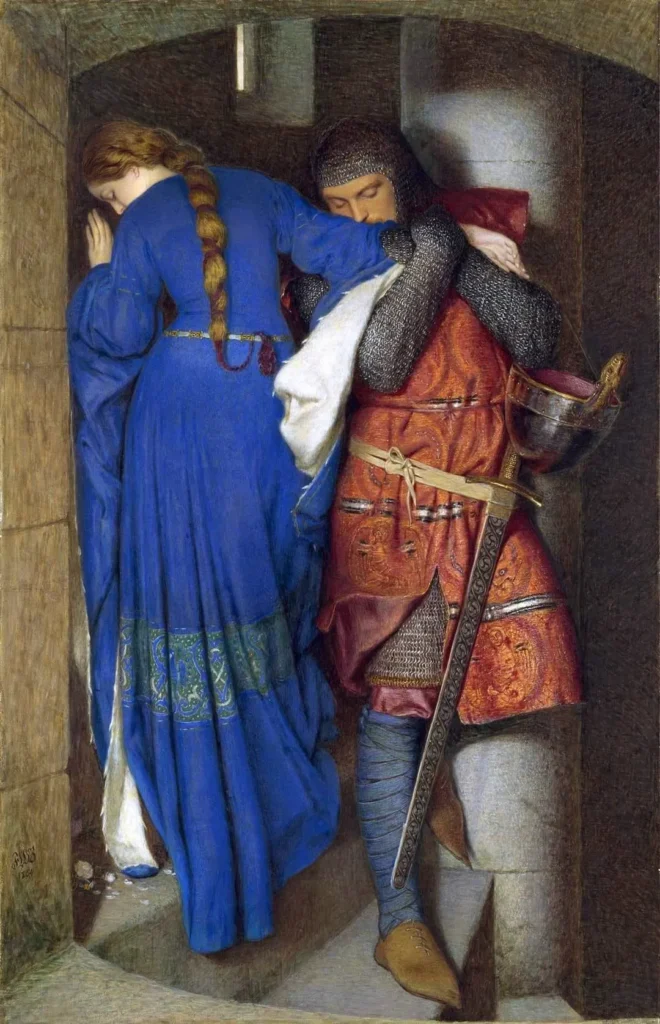
The Painting
I first encountered The Meeting on the Turret Stairs while scrolling through Facebook.
Something about it stopped me.
I couldn’t have told you why at first.
I only knew I felt something.
Longing.
I felt it in my body and in my soul.
The painting spoke to me. It drew me in. I found myself staring at it, feeling as though I could sense something moving beneath the image itself. I could feel their love. Feel their longing. Feel their goodbye. Their last touch.
I didn’t know who they were.
I didn’t know their story.
But I knew I wanted to know more.
As I began reading about the painting, I discovered something unexpected. Because of the fragility of the watercolor, it can only be displayed for a few hours each week. The rest of the time it sits in darkness.
That fact captivated me almost as much as the painting itself.
I found myself imagining the lovers spending most of their existence hidden from view. Waiting in the darkness. Holding their secrets. Their love. Their longing. Their joy. Their grief.
Then, for a few brief hours each week, they emerge once again.
Visitors gather.
Eyes meet theirs.
Hearts are stirred.
Questions arise.
And then they return to the darkness.
The more I thought about it, the more it felt like a metaphor for the stories we carry within us.
How much of our lives remains hidden?
How much love, grief, joy, heartbreak, resilience, and longing lives quietly beneath the surface, unseen by the world around us?
Most people encounter only a few illuminated moments of our lives.
The rest remains in the shadows.
Waiting for someone to ask.
Waiting for someone to listen.
Waiting for someone to see.
My Own Longing
The painting had already awakened something in me.
It tapped into my own longings.
And as I sat with it, I found myself thinking about my Aunt Lillian.
Last fall, I spent a couple of weeks in Florida. During that trip, I spent a few days with my aunt. She had turned 91 that summer. She was my last surviving aunt.
I can honestly say she brought me joy my entire life.
Through the years, we shared it all. Joy. Laughter. Grief. Sadness. Love.
Lots of love.
One of the gifts of that visit was the time we spent together in the car. We took a long drive and did what we had done for decades. We shared stories. Memories. Insights. Pieces of our lives.
At the time, it felt like another conversation.
Another visit.
Another drive.
Little did I know it would be the last time I would see her.
A few weeks ago, she died just a few months shy of her ninety-second birthday.
When I looked at this painting, I found myself longing for her.
Longing for one more conversation.
One more story.
One more laugh.
One more drive.
The painting stirred something I couldn’t quite name at first because it wasn’t just their longing I was feeling.
It was my own.
Their goodbye touched my own experiences of goodbye.
Their love touched my memories of love.
Their loss touched my own losses.
And isn’t that what great art does?
It reaches across time and circumstance and reminds us of something deeply human.
The details may be different.
The centuries may separate us.
But love is still love.
Longing is still longing.
Grief is still grief.
And the ache of wishing for one more moment with someone we love is timeless.
What Grief Has Been Teaching Me
I found myself thinking about something else.
When Aunt Lillian died, I felt regret.
Not because we hadn’t spent time together.
We had.
Not because things had been left unsaid.
They hadn’t.
But because when I first began dreaming about my Birth to 100 and Beyond project, she was one of the first people I wanted to talk to.
I thought there would be more time.
I thought I would call her later.
I thought I would get around to recording her stories.
Then life did what life does.
It moved forward.
And before I knew it, the opportunity was gone.
Or so I thought.
Because grief has been teaching me something.
Death ends a life.
It does not end a relationship.
When I look at this painting, I realize I am still in relationship with Aunt Lillian.
I still hear her laughter.
I still remember the stories.
I still carry the love.
In some ways, the painting sitting in darkness reminds me of that.
The story is not gone.
It is simply waiting.
Waiting to be remembered.
Waiting to be spoken.
Waiting to emerge into the light once again.
The Story Behind the Painting
Only later did I discover the story behind the painting.
The Meeting on the Turret Stairs is based on a medieval Danish ballad about Hellelil and Hildebrand. Hellelil falls in love with her bodyguard, Hildebrand. When her father learns of their love, he sends her seven brothers to kill him. The painting captures the moment before Hildebrand leaves to meet them.
It is their final goodbye.
Before he departs, he kisses Hellelil and asks one thing of her: should she witness the battle, she must never call out his name.
Hildebrand defeats six of her brothers. When he faces the youngest, Hellelil can no longer bear what she is seeing. Forgetting his request, she cries out to him and begs for mercy. Hildebrand relents. In that moment of compassion, the youngest brother kills him.
The tragedy continues. Hellelil is dragged away, imprisoned, tortured, and eventually sold. Years later, after recounting her story to a queen she serves, she falls down dead herself.
Knowing this story changes the painting entirely.
The touch of their hands is no longer simply romantic. The moment becomes charged with grief, courage, fate, and loss. What appears at first to be a beginning is actually an ending.
And yet, if no one had told me the story, I would have brought my own.
That is the magic of art.
The Story We Bring
Art doesn’t simply show us something.
It invites us to participate.
One person sees romance. Another sees longing. Another remembers a first love, a goodbye, or a choice that altered the course of a life.
The painting remains the same, but the experience is different for every person who stands before it.
The story is not only in the art.
The story is in us.
What struck me most was how often life works this way. We rarely know the full story when we are living a moment. We only know what it becomes in hindsight.
A goodbye that seemed ordinary becomes the last conversation.
A chance encounter becomes the beginning of a lifelong friendship.
A decision that felt insignificant becomes a turning point.
Looking at the painting without the story, we see romance.
Looking at it with the story, we see sacrifice and heartbreak.
Neither view is wrong.
There is always more beneath the surface.
As someone who spends much of my time listening to people’s stories, I am continually reminded of this truth.
We look at a photograph and see a smile.
We hear someone tell a brief anecdote.
We pass a stranger in a grocery store.
What we don’t see are the chapters that came before.
The grief.
The resilience.
The impossible choices.
The loves lost and found.
The moments that changed everything.
Every person is carrying a story far larger than the moment we happen to witness.
Why Stories Matter
I’ve been thinking about this in relation to my work as a storyteller and scribe.
When I sit down with someone for a Voices That Matter conversation, they often arrive believing they are coming to tell a story.
What frequently happens instead is that they begin discovering one.
A memory surfaces.
A connection becomes clear.
A moment they had forgotten reveals itself as pivotal.
The story was always there, waiting to be seen.
Art can do the same thing.
A painting, a song, a poem, a photograph, a piece of music—each can act as a doorway into parts of ourselves that have been quietly waiting for our attention.
Sometimes we encounter a work of art and think we are observing it.
In reality, it is observing us.
It reveals what is alive within us in that moment.
Why does one image stop us in our tracks while another leaves us unmoved?
Why does a particular song bring tears to our eyes?
Why do certain stories stay with us for years?
Perhaps because they touch something that was already present.
The art becomes a mirror.
Fragile Things
As I sat with this painting, I found myself returning to the reason it first caught my attention.
Its fragility.
The painting can only be displayed for a few hours each week because too much light will cause it to fade.
There is something profoundly human about that.
We are fragile too.
Our memories fade.
The people we love leave this world.
Stories that once lived vividly in someone’s heart can disappear within a generation if they are never shared.
Perhaps that is one of the reasons I feel so called to the work of listening and storytelling.
Every conversation I record through Voices That Matter and Birth to 100 and Beyond feels, in some small way, like preserving a painting that might otherwise fade from view.
Not because the stories are fragile in themselves.
But because memory is.
A life can be filled with wisdom, heartbreak, joy, humor, resilience, and love.
Yet if no one asks, if no one listens, if no one records it, much of that richness can quietly disappear.
The painting survives because people recognized its value and chose to protect it.
Stories survive in much the same way.
Someone must listen.
Someone must remember.
Someone must care enough to preserve what might otherwise be lost.
A Doorway Into Ourselves
What fascinates me about The Meeting on the Turret Stairs is that the painting holds both stories at once.
It holds the story of Hellelil and Hildebrand.
And it holds the story each viewer brings to it.
Perhaps that is why it moved me before I knew anything about the Danish ballad behind it.
The painting had already found a doorway into my own heart.
It had touched something familiar.
Something human.
Something longing.
Perhaps that is why this fragile painting continues to captivate people more than 150 years after it was created.
It is not simply about two lovers on a staircase.
It is about the mystery of what lies beneath every moment.
It is about the stories hidden inside us.
And maybe that is one of art’s greatest gifts.
Not that it tells us what to think.
Not that it gives us answers.
But that it creates an opening.
A doorway into our own story.
The next time a piece of art moves you, pause for a moment before asking what it means.
Instead, ask what it awakens.
The answer may tell you as much about yourself as it does about the art.
And perhaps, if you listen closely enough, it may also reveal a story waiting to be told.
Jennifer Mark is a writer, storyteller, and founder of Voices That Matter – The Scribe Project, where she companions individuals in sharing and preserving the stories, wisdom, and experiences that have shaped their lives.