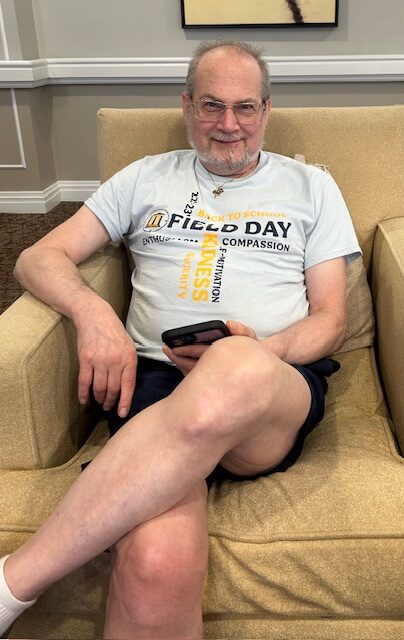
David-61
I love traveling. I would travel anywhere.
This particular trip developed from a conversation I was having with some colleagues of mine. I was working in a lab at NYU, and there was a Friday happy hour that I would go to every week. For whatever reason, I wound up hanging out with all the Russians. We would have good conversations over beer.
We were talking about travel one time, and I expressed how much I loved it. Off the top of my head, I mentioned Mongolia. I said I would love to go there. It’s flat and boring, but the history is so fascinating to me.
One of my colleagues told me he still had an apartment in Moscow and that, if I ever went there, I could stay in his apartment.
That got me thinking.
With my wife and stepdaughter, I planned a trip. We would fly into Helsinki and spend some time with a family I knew there. I had been an exchange student in Finland as a teenager, so we would stay with that family. Then we would take the ferry to Tallinn, Estonia.
The Jewish side of my family comes from Latvia, so I added Latvia to the trip. After that, we would go to Russia, return to Finland, and then go home.
Tracing My Family to Latvia
I became interested in genealogy around the time my daughter was born. It took me a long time, but I was able to trace my ancestors to two towns in Latvia.
I found records from my family on a Jewish genealogy website. I was able to find the exact addresses where my family had lived.
One of those towns was Rēzekne, where my grandmother was born.
My grandmother had always said she was born in the United States, but I found records of her in Latvia. She only moved to the United States when she was very young. I forget if she was two or five, but she was very young.
I managed to hook up with the very tiny Jewish community in Rēzekne. Someone from the community, along with a Latvian translator, showed us around all the addresses connected to my family.
Most of the buildings were gone by then. There was one building that still existed where one branch of my ancestors had lived. There was also an empty lot where my great-grandfather and great-grandmother had lived and where my grandmother was born.
Right between the two was the last surviving synagogue in Rēzekne.
Rēzekne had been about half Jewish until around 1905. There had been approximately thirteen synagogues, but only one survived. All the others had been destroyed in pogroms or during World War II.
Five Thousand People Beneath My Feet
Before visiting the synagogue, we saw the site where the last remaining Jews of Rēzekne, about five thousand people, had been lined up and machine-gunned to death.
It was a long, narrow, grassy field.
I walked from one end to the other, and it took a long time to walk the whole distance. I kept thinking to myself, five thousand people were killed right here. They are underneath my feet.
They also showed us the Jewish cemetery, where you could still see bullet damage in the headstones.
All of that was in my mind when we arrived at the synagogue.
It was a wooden synagogue. Wooden synagogues used to be very common in Eastern Europe, but it is now very unusual for one to have survived. The building was painted green, so it was known as the Green Synagogue.
It was condemned and in terrible shape, but we went inside anyway.
As we were walking toward it, there was a construction site next door. The construction workers yelled things at us. We did not need the translator to know they were shouting antisemitic things.
We ignored them and went into the synagogue.
The Last Synagogue They Ever Saw
The synagogue was right in the neighborhood where my family had lived.
We were told that the only reason it survived World War II was because it was near the railroad tracks. Jews would spend the night in the synagogue while they were being transported to the death camps.
For many of them, it was the last synagogue they ever saw.
All the other synagogues in the town were destroyed.
It had also been my family’s neighborhood synagogue. I have no idea if my family was ever inside, but they probably were. They may have attended weddings there. Some of them may even have been married there themselves.
I sat inside that condemned, decaying building, thinking about all the Jews who had passed through it on the way to their deaths. I thought about my family living only a few blocks away.
In the back of my mind, I was thinking, I’m going to try to save this building.
Trying to Save the Green Synagogue
I had never done anything like that before, but I tend to be very active and get involved in things. I was involved in Brooklyn politics for quite some time. I take on projects.
I had no idea how to save a synagogue in Latvia, and I am terrible at raising money. I cannot raise money for anything.
Still, I started reaching out to anyone I could find who had Jewish ancestors from Rēzekne. I tried to generate some interest in saving the building.
The roof was collapsing and leaking. There was water damage everywhere.
Somehow, I got connected with an organization called the World Monuments Fund. Someone there encouraged me to apply for a grant.
The grants were not large, so I applied for enough money to conduct a site survey and create a restoration plan blueprints for renovating the synagogue.
I got the grant.
I think it helped that one of the people on the committee deciding the grants also had ancestors from Rēzekne. They took an interest in the project.
It was a small grant, but the World Monuments Fund hired an engineering and architecture firm in the town. The firm completed a site survey and came up with a restoration plan.
Then they emailed me the blueprints.
I was not able to find enough additional interest or funding to continue the restoration myself. But because of what I had done, and because people whose ancestors came from Rēzekne were beginning to return and visit the town, the local government took an interest.
They stabilized the building, repaired the roof so it was no longer leaking, and stopped it from continuing to decay.
That was where things remained.
An Email from Norway
About ten years later, completely out of the blue, I received an email from someone in the Norwegian government.
They asked me if I knew anything about the Green Synagogue of Rēzekne.
I said, “Yes. What do you want to know?”
Norway and Latvia were involved in some sort of joint cultural project. One of the projects they were considering was restoring the Green Synagogue. They had heard about it somehow and thought it might be something they were interested in.
Then they asked me, “Do you know where we could find any blueprints or plans for restoring it?”
I said, “Yes. Here you go.”
I emailed them the blueprints.
Over the next couple of years, they restored the synagogue.
It is now a museum of tolerance.
Unfortunately, I have not been back. I would love to return and see the restored building if my health and finances ever allow it. I have seen pictures online, and they did a very good job.
I was not able to restore it myself, but with help from the World Monuments Fund and the Norwegian government, the synagogue was restored.
Preserving What Others Tried to Erase
To me, saving the synagogue was a little bit of an act of defiance.
The history of Latvia during World War II was not good. Latvians collaborated with the Nazis in killing Jews. Restoring the synagogue was my response to all the people who tried to erase the Jewish history of Europe.
I am not terribly religious. I was raised secular. I describe myself as a borderline atheist Jew with Buddhist sympathies.
But I was always raised knowing I was Jewish. I knew we were somewhat different because we were Jewish, and I knew Jewish history.
Being able to take that act of defiance meant something to me, as did the connection to my ancestry.
Years earlier, during my involvement in Brooklyn politics, I got to know a politician named Bill Batson. My then-wife and I liked him and campaigned for him.
There are many Underground Railroad sites in Brooklyn, most of them obscure. There were often fights between historical societies and civil rights groups that wanted to preserve those places and developers who wanted to build giant buildings.
During one of those fights, Bill gave a speech to a political group I was part of. One line stayed in my mind:
If you can destroy someone’s history, you can do whatever you want to them.
I thought about those words when I took on the synagogue.
My original thinking was about the Holocaust and my connection to my family, but it was also about Jewish history. Many towns in that part of Eastern Europe had populations that were fifty percent Jewish or more. Jewish people were a major part of the history of those places.
There had been an attempt to erase that history.
If you destroy someone’s history, if you erase someone’s history, you can do whatever you want to them.
Saving the Green Synagogue was my response to that idea.
My great-grandfather probably entered that synagogue and lived only a few blocks away. He was also the brother of the great-grandfather of the punk rocker Henry Rollins.
I have never met Henry Rollins, but I did speak to his grandmother on her hundredth birthday. She was as grumpy as could be, and that is sort of my family.
Grumpy and long-lived.
I do not know if I will have the long-lived part. I am not as healthy as I used to be. But we definitely have grumpy and long-lived genes in my family.
Restoring the Green Synagogue may have been one small thing, but being able to take that act of defiance meant something to me.
It preserved a part of my family’s history and a part of Jewish history that others had tried to erase.
Scribe’s Reflection
David’s story reminds me that preserving history is not only about remembering the past. Sometimes, it is an act of resistance.
What began as a journey to trace his family’s roots became something much larger. Standing in the Green Synagogue, surrounded by the history of his ancestors and those who passed through its doors on their way to death camps, David felt a responsibility to act. He did not know how to save a synagogue, and he could not complete the restoration alone. Still, he took the first step.
Years later, the plans he helped create became part of the synagogue’s restoration. What might have disappeared became a museum of tolerance and a living witness to the Jewish community that once called Rēzekne home.
One line in David’s story stays with me: If you can destroy someone’s history, you can do whatever you want to them.
David’s act of defiance shows us the other side of that truth. When we protect a place, preserve a memory, or tell a story, we affirm that these lives existed and mattered. We refuse to allow them to be erased.
Sometimes one person’s decision to remember is enough to keep history alive.
Jennifer Mark, Scribe
Voices That Matter
Storytelling as legacy. Listening as medicine
This story is part of Voices That Matter: Birth to 100 and Beyond.
Every age holds stories worth telling. Every voice matters.
There is no cost to participate, only a willingness to share a story.
This project is sustained through those who share their stories, spread the word,
or contribute to its continued creation and growth.
I would love to include your story in this growing living archive.
Learn more about Voices That Matter — Birth to 100 and Beyond and other current projects.
A life is made of moments that are often easy to overlook while we are living them.
Birth to 100 exists to pause, listen, and preserve those moments before they disappear.
Because every life carries something worth remembering.