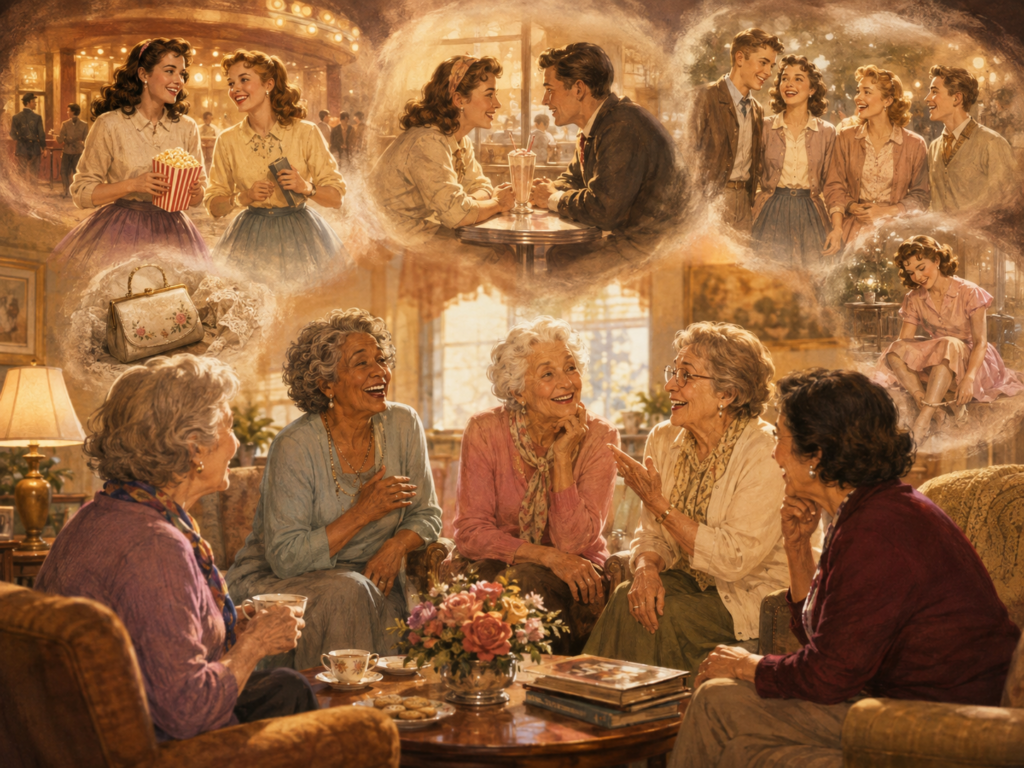
That afternoon became a beautiful reminder of what happens when women of different generations come together and begin sharing stories. A thread appears. We recognize something of ourselves in one another. Memory becomes connection, and ordinary moments that might otherwise have been forgotten become alive again through the telling.
This month, rather than highlighting one individual voice, we celebrate the voices of the circle together.
Different women. Different generations. Different lives. And one shared memory that filled the room with joy and laughter. That is the heart of Voices That Matter-Atria Stories.
When one person is given the space to speak, and another is willing to listen, connection becomes possible.
One conversation. One story. One voice that matters.
Do You Remember Your First Date?
A Voices That Matter Story Circle
The Question
It started with a simple question: Do you remember your first date?
For a moment, there was laughter.
When you are sitting in a room with people whose lives span decades, first date can mean reaching back a very long way. “Oh my God,” one woman said. “That’s 98 years.” She was 98 now, but she could still find the girl she had been.
“I was about 14,” she remembered. “We were just a bunch of kids together. One boy asked me if I would like to go to the movies with him.” “That counts,” we decided. “That’s a date.”
Then came the obvious question: “Did he kiss you?” “Oh, no!” More laughter.
The movie itself had disappeared from memory. When we asked what it was, she answered, “Absolutely not.”
The movie was gone, but somehow, the boy asking her to go remained.
That is the strange thing about memory. We don’t always get to decide which details stay. A movie title disappears, but the feeling of being 14 and being asked out can survive more than eight decades.
Hilda Wins
Then Hilda spoke. She had met someone when she was 16, and she was still with him.
The room stopped.
“Wait. You’re still with him?”
She was. Her first date had become the person she would share her life with. Suddenly there was an unofficial contest nobody knew we were having. “I don’t think I’ve ever met anybody who is still with their first date.” Hilda had clearly won.
Another woman remembered being about 12 when she went to a movie with a boy. They already knew one another because they were neighbors, and there was nothing dramatic about it.
“It was nice.”
Sometimes that is all a first date needs to be: nice, a movie, a familiar boy, a memory tucked somewhere inside a lifetime.
Anthony Catella and a Seven-Year-Old Date
Then I had to confess that if we were really talking about first dates, mine happened in second grade. I was seven.
His name was Anthony Catella. He was my best friend, and somehow, at seven years old, Anthony formally asked me on a date. Even then I knew this seemed questionable.
“I can’t go on a date. I’m seven.”
But Anthony apparently had things handled. He and his parents picked me up in the car and took me to dinner and a movie. His parents came, of course. We were seven.
Anthony and I remained best friends for another year until my family moved to Florida. I didn’t see him again until I was around 35 and came back to visit.
He had changed a little since second grade, but when we talked about that first date, he remembered it too.
All those years later, the two seven-year-olds were still somewhere inside us.
If we disqualify that date because of the parental chaperones and our inability to reach the restaurant table without booster seats, my next one came at about 14. That was a group date.
I belonged to a singing group called Sing Out, and a bunch of us went together to see Barry Manilow: my first concert and my first teenage date. There are worse beginnings.
By then, the question had opened the room. People began reaching backward, searching through the years.
The Heshi Story
Later, another woman joined us. She had fallen asleep and worried that she had missed something.
“You didn’t miss anything,” we told her. “We’re talking about our first dates.”
She thought hers had been with a boy named Heshi when she was about 15.
She had gone to an all-girls school, so opportunities to meet boys had been limited. Her mother wasn’t involved in synagogue groups or social organizations where young people might naturally meet.
“We were students,” she said. “That’s what we did. We studied like crazy.”
A Girdle in a Pocketbook
But she did remember one date particularly well—not because of romance, but because of her girdle.
In those days, women squeezed themselves into all kinds of undergarments—girdles, garter belts, stockings, things younger generations may know only from old photographs.
She was out on a date when her stomach began bothering her. There was only one solution: she went into the bathroom, took off her girdle and put it in her pocketbook.
“That was the most memorable thing.” The room erupted. “You took your girdle off in the middle of the date?” She clarified immediately. “I went into the bathroom. I was decent.”
Some stories simply refuse to be forgotten.
The Toilet Seat Lecture
Then somehow first dates led us to the story of another husband—one who had been introduced to his future wife while giving a lecture connected to his work.
His business? Toilet seats.
There are moments in a story circle when you know you have lost control of the original theme. This was one of them.
“So you went to the lecture?”
She did, and eventually she married him. Apparently, a lecture about toilet seats can be more seductive than anyone realized.
Soon we were remembering the colored toilet seats people used to have, the cushioned ones, jobs that no longer seem to exist, and the funny ways people once met the person who would become their spouse.
When Memory Becomes a Doorway
Underneath all the laughter was something tender. A question about first dates had become a doorway.
For a few minutes, age disappeared. The women sitting in the room were also 12, 14, 15 and 16: one walking into a movie theater with a neighborhood boy, one agreeing to a date with the young man she would still be beside decades later, one quietly removing an uncomfortable girdle and stuffing it into her purse, and somewhere in the circle, a seven-year-old girl being picked up by Anthony Catella and his parents for dinner and a movie.
That may be what happens when we tell stories together. We don’t simply remember what happened; we remember versions of ourselves that are still there: the teenager, the young woman, the girl who did not yet know whom she would marry, where she would live, whom she would lose, what family she would build, or how many years would pass before someone sitting in a circle asked, Do you remember your first date?
The Room Filled with Girls Again
And somehow, we do.
Maybe not the movie, every name or exactly what was said, but a boy asking, a theater, a laugh, a girdle in a pocketbook, a husband who began as a first date.
Tiny pieces of ordinary life seemed insignificant when they happened and became precious because they survived.
For an afternoon, we gave them back to one another, and the room filled with girls again.
Scribe’s Reflection
What I loved most about this circle was how quickly one simple question changed the energy in the room: Do you remember your first date?
Almost immediately, stories began arriving—some clear, some incomplete, some funny enough to bring the whole room into laughter.
What struck me was how little the details mattered. Someone could forget the name of the movie but remember being asked. Another could recall a date because of an uncomfortable girdle. Someone else remembered meeting the person who would remain beside her for decades.
These were not necessarily the moments anyone would have thought to record when they happened, yet all these years later, they were still there.
That is part of what continues to move me about this work. The stories that matter are not always the dramatic ones. Sometimes they are the ordinary moments that quietly carry a whole version of who we once were.
As the women shared, the differences in age around the circle seemed to soften. We were not simply women at different stages of life. For a while, everyone had access to the girl she had once been—the girl going to the movies, wondering what might happen, laughing with friends, feeling awkward, curious, excited or unsure.
And as each story was told, it gave someone else permission to remember.
That is the beauty of a story circle: one memory opens another, one person laughs and the whole room joins her, and one woman remembers who she was, somehow helping us all remember a little more of ourselves.
By the end of the conversation, I was reminded again that storytelling does more than preserve the past. Sometimes, it brings a part of us back into the room.
Every resident carries a lifetime of moments, memories, losses, laughter, love, and wisdom that deserve to be seen and remembered.
Atria Stories exists to pause, listen, and honor the lives that have shaped families, communities, and generations.
Because these are not just stories from the past.
They are living legacies still unfolding.