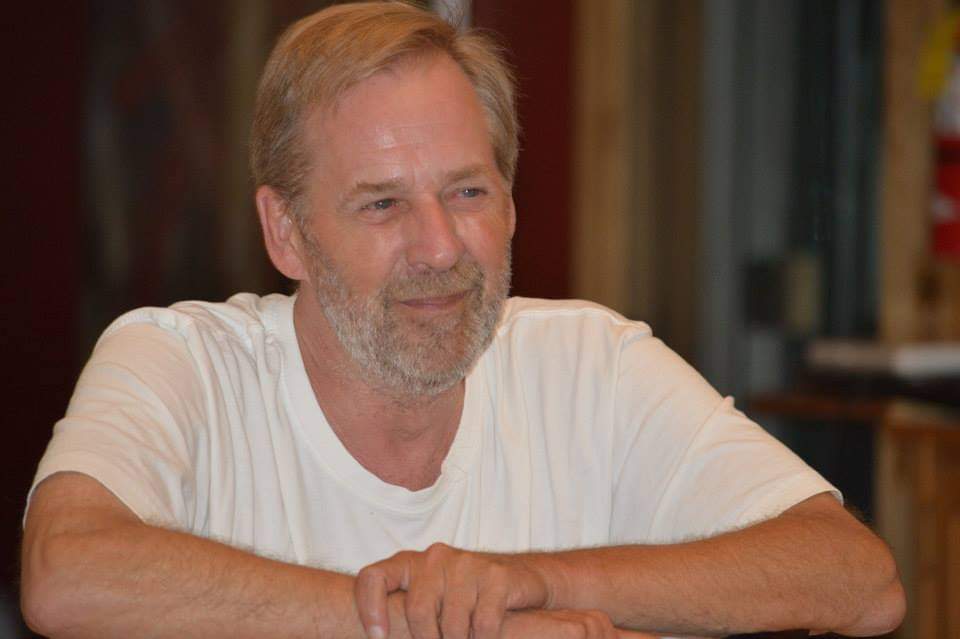
My Spiritual Home
I’m a storyteller. I’m an actor, director, and writer, so my whole world has been about stories. I think that was part of what drew me to Shalom right away. People sat down and told their stories. They weren’t afraid, or they were afraid and went ahead and did it anyway, because they needed to. We all need to tell our stories. The perfect moments and the not-so-perfect ones as well.
Finding My Way to Shalom
I first came to Shalom twenty-some years ago. I’m not quite sure exactly when, but I remember how I was introduced to it.
I had suffered a monumental breakup in a relationship. It was monumental for me, anyway. I was living on the beach at the time, and I would walk the beach four, five, six times a day, crying my eyes out. I did that for over six months. Eventually, I started saying to myself, “This is not normal. This is not normal.”
So I started seeing a therapist, and she recommended something to me. It was a Shalom retreat in Gloucester with Yana and Meg Ryden. I had no idea what these retreats were, but I went. That therapist was Bonnie Moore, who I ended up sharing a house with for many years later on.
I went to three or four retreats before I ever came to the mountain itself. I remember those early experiences, and I especially remember my first night at Shalom Mountain.
My First Night at the Mountain
We arrived on a Thursday night because Bonnie was part of the planning committee. There were only about half a dozen people there, maybe ten. She had a meeting, and I was doing whatever I was doing while she finished up. Afterward, somebody said they were going into the hot tub and asked if I cared to join them.
Within four hours of being at the mountain, I was naked in a hot tub with a bunch of strangers! That was bizarre to me, but what a wonderful introduction.
It was a work weekend, so hardly anybody was there that first night. The next day, everybody arrived, and suddenly there were about a hundred people. I made immediate friends with so many of them.
I remember that first work weekend because of something that happened with Monty. Bonnie had mentioned the talent show, and Monty had never done one before. He had always wanted to do “Who’s on First?” by Abbott and Costello. I said, “Well, let’s do it!”
We were working on a staircase or something, and over the course of the afternoon, I finally talked him into it. It was just so wonderful to see him get up there. Monty was a quiet worker guy. He showed up, did the work, and kept kind of quiet. To see him step into the spotlight and shine was just so, so wonderful.
There would be a lot more work weekends and retreats at the mountain over the years, but when I think about what kept bringing me back, one word comes to mind: peace.
The Peace of Shalom
I don’t know exactly how to explain it. I just accepted it. No matter how conflicted I might be in the rest of my life, with complicated relationships, past trauma, and all that nonsense we taunt ourselves with, something shifted when I came to Shalom.
As soon as I’m there, the peace starts. I know I’ll be safe, that whatever I bring with me will be treated kindly and with love. That doesn’t mean difficult things never happen. They do, but so rarely that I can hardly think of anything beyond the things I might bring with me.
That feeling gave me room to experience things I might never have allowed myself otherwise.
Learning to Trust the Process
I remember my very first retreat with Yana and Meg. They were working with somebody else, and I was sitting in the circle, crying uncontrollably. The woman sitting next to me held me.
Later, while a man was having his mat trip, Yana motioned for me to come forward. She wanted me to play a part in his process. There I was, a blubbering mess, and she’s motioning me over. I’m trying to tell her I’m not doing that, but she got me to do it.
I think that says something about how comfortable I felt with Yana right away. Even in that condition, when I didn’t think I could do something, there was enough trust for me to participate.
Another memory comes from my second or third retreat. I don’t remember exactly which one or who was leading it. We were sitting and talking before getting into the breathing and everything else, and I admitted that I was fearful.
The leader asked me, “What are you afraid of?” I said, “I’m afraid I’m going to have a psychotic break.”
She looked at me and asked, “Have you ever had a psychotic break?” When I said no, she replied, “You probably won’t.”
That little bit of levity was enough to release the fear. It was just a conversation, but it made such a difference. I was discovering that sometimes something as simple as a question, a little humor, or another person’s presence could change an experience entirely.
Bringing Shalom Into My Work
I’ve always been pretty open to new experiences. I have to be, not only because of my acting but because of the work I do. For about twenty-two years, I’ve been a group facilitator working with men who have been convicted of domestic violence. I’m seventy-four years old now, and I’m still doing it. I’ll keep doing it until they tell me not to come anymore.
In that work, I have to be prepared for whatever somebody might say. Something they say might be a lead, or it might be a connection. I have to be open to it.
People have asked me over the years whether I bring Shalom into my work. For the first few years, I was working in a jail environment, and bringing the Shalom process into that setting didn’t seem appropriate, so I never tried it.
More recently, maybe a year ago, I decided to introduce some of the skills and principles of loving into the groups. I did a couple of sessions, and it was okay, but it wasn’t really a good fit. The way Shalom has affected me as a counselor is something different.
I’ve learned that you don’t necessarily teach these things by talking about them. How do we learn things? We don’t learn them just by hearing them. We learn by seeing them.
I’m constantly reminding the guys of something Maya Angelou said, that people may not remember what you say or even what you do, but they will remember how you made them feel. I ask them, “Do you want to be the guy who made people feel fearful, or do you want to be the guy who made them feel loved?”
That leads us into a discussion about love being an intention.
In my work, I use the word intention in a particular way. I tell the guys that you cannot act without an intention. When you act, you want something to happen. You have something in mind that you want to happen when you do that. So when you say, “I didn’t mean to,” that’s not necessarily true. You wanted something to happen.
Well, love is the same thing. Love is an intention.
I think Shalom is so much about respect. Respecting people’s boundaries, respecting people in their brokenness and in their joy. Those are things that fit with everything I believe in anyway, and they’ve become part of the way I approach my work with others.
A Hug From Jerry Jud
When people ask me about Shalom, or when I bring it up in conversation, I usually start by saying, “Let me tell you about my spiritual home.”
Then I tell them some of these memories and what the experience has meant to me. Maybe they’ll take it a little more seriously. Maybe it will become just as important to them.
There’s another memory that stays with me, and that’s the first time I met Jerry Jud. I had been coming to Shalom for quite a while before I ever met Jerry. I didn’t meet him until sometime in the 2000s.
I was late getting to Shalom that day. By the time I arrived, it was already evening, and everybody was out in the pavilion dancing. You know how crazy that gets. People were dancing away, and I was making my way around the edges, looking for somebody I knew, somebody I could hug.
I looked over into a corner, and there was this old man sitting under a post. There was a path between us. It was almost as though everything had separated somehow, leaving this clear space.
He saw me. He had never seen me before, and I had never seen him before. But he stood up, walked over to me, and gave me a big hug. That was the first time I ever saw him.
And that was exactly what I needed at that moment. I thought I would get that hug from somebody I knew, but it came from him. I didn’t even know who he was.
That was my introduction to Jerry Jud. We had several conversations after that, but I’ve never forgotten that first meeting. It goes back to what Maya Angelou said about how people remember the way you made them feel. That hug was exactly what I needed, and I remember it all these years later.
I Wouldn’t Dare Change My Life
I’m getting older now. My heart is weak, but it’s keeping me alive. I’ve had heart attacks, plural, and I use oxygen. I’m feeling older than I think I’ve ever felt before.
But I’ve got a right to be. I’m old! I don’t want to hear any of this business about seventy being the new fifty. That’s bullshit. I’m old, and I’m okay with saying that.
People sometimes ask me, “If you could go back and change anything in your life, what would you change?”
And I say, “I wouldn’t dare. I wouldn’t dare.”
There’s plenty of stuff I’ve fucked up in my life. I drank for twenty-two straight years. I made a mess of my life. I’ve been sober for thirty-four years now.
All kinds of things have happened to me over the years, and there are certainly things I wish hadn’t happened, particularly because of the pain they caused other people. But would I go back and change any of it? No.
Because everything I’ve experienced- the heartache, the pain, the suffering, the joy, the happiness, and the love- all of those things have contributed to who I am now. And I am so happy to be who I am now.
A New Generation at Shalom
Shalom has been part of that journey, and I still consider it my spiritual home, even though I can’t drive out to the Catskills anymore.
I did get out there for a work weekend a couple of years ago, and something about that visit really excited me. There weren’t the crowds we used to have, but what excited me was how young the people were. How wonderfully, wonderfully young!
They had made Shalom their own. They had taken it and brought it to another level.
I think about the various leaders along the way, different people taking different things under their wing, and I have great confidence in a lot of these new people. Their hearts are in the right place.
I’ve heard people say that Shalom isn’t the same as it used to be. And I tell them, “It’s not supposed to be the same as it used to be.”
That doesn’t bother me. I think it’s wonderful that a new generation is making it their own.
Perfect Moment for Today
There’s one other thing I like to tell the guys I work with, something I think is important for everybody to remember.
St. Augustine spoke about how all we have is this moment. The moment we think about it, it’s gone, and we’re already in another moment. He asked what we can do in that moment but praise God.
But what I find particularly important is this idea that from moment to moment, you are a perfect individual. Right now, in this moment, you are a perfect individual. And in the next moment, you will be a perfect individual.
I think that’s so important to remember.
I’ve lived a lot of years, made a lot of mistakes, experienced a lot of joy and suffering, and had the good fortune to find people and places that have helped shape who I am today.
When I think about Shalom, I think about the stories, the laughter, the tears, the work weekends, the retreats, and the hugs that came exactly when I needed them. I think about the people who were there twenty-some years ago and the younger people who are carrying it forward today.
And underneath all those memories is the feeling that has remained with me from the beginning. It’s why, when someone asks me about Shalom, I call it my spiritual home.
Scribe’s Reflection
There is something about listening to someone tell a story that reminds me how much of our lives is shaped by moments we might not recognize as important until years later. A conversation, an unexpected invitation, a stranger’s kindness, or simply finding ourselves in a place where we can finally exhale.
As I listened to Mark, I found myself thinking about what it means to find a spiritual home. Not necessarily a place where we agree with everything or everyone, or where life suddenly becomes easier, but somewhere we experience enough safety and belonging to bring more of ourselves into the room.
Mark came to Shalom through heartbreak. He was grieving the end of a relationship, walking the beach day after day, trying to find his way through something he couldn’t quite understand. I imagine that when he first attended a retreat, he had little idea how much that experience would become part of his life.
And perhaps that’s often how these things begin. We arrive looking for relief from one particular pain and discover something much larger than what brought us there.
The Gift of a Perfect Moment
One of the moments in Mark’s story that stayed with me was his first meeting with Jerry Jud. I could picture him arriving late, walking around the pavilion, looking for someone familiar to embrace. Instead, a man he had never met got up, crossed the space between them, and offered exactly what he needed.
A hug. No explanation. No history required.
I’ve been thinking about how often we underestimate those moments. We may never know what another person is carrying or what our simple act of kindness might mean to them. Yet decades later, Mark still remembers that embrace.
Perhaps that was a perfect moment, not because anything extraordinary happened, but because two people met without expectation, and something meaningful unfolded between them.
When Love Becomes an Intention
I was also struck by the way Mark speaks about his work with men who have been convicted of domestic violence. He doesn’t describe bringing Shalom into that work through a particular exercise or teaching. Rather, he recognizes that what we learn about love, respect, boundaries, and personal responsibility becomes meaningful in how we live and how we treat others.
He speaks about love as an intention.
That stayed with me because intention, without action, can become just another lovely idea. We can talk about compassion, acceptance, and love all day long, but how do those qualities actually show up in our lives? Especially when we are uncomfortable, challenged, or sitting across from someone whose choices we may find difficult to understand?
For me, that’s where the deeper work begins. Not in deciding that everything someone has done is acceptable, but in recognizing that accountability and humanity don’t have to be opposites.
Making Peace With the Life We’ve Lived
There was another part of Mark’s story that made me smile. At seventy-four, with his health presenting real challenges, he has no interest in pretending that aging is something other than what it is. He is getting older, and he isn’t interested in dressing that up with cheerful slogans.
I appreciated that. There is a freedom in being willing to tell the truth about where we are, without making that truth the entirety of who we are.
And then there is his response to the question of whether he would change anything about his life.
“I wouldn’t dare.”
Those three words hold so much.
Mark doesn’t pretend he hasn’t made mistakes. He speaks openly about his years of drinking, his sobriety, the pain he has experienced, and the pain he has caused. He doesn’t erase any of it. Yet he recognizes that his life, all of it, has brought him to the person he is today.
I find myself considering the distinction between accepting our history and excusing it. They aren’t the same thing. We can acknowledge the harm, take responsibility where responsibility belongs, and still find gratitude for the person we have become.
Perhaps one of the greatest gifts of growing older is the possibility of holding more than one truth at a time.
And maybe recognizing a perfect moment doesn’t require us to believe that everything leading up to it was perfect. Perhaps it simply asks us to recognize where we are now, without needing to rewrite everything that came before.
Allowing What We Love to Evolve
I also loved hearing Mark speak about the younger generation making Shalom their own. There was no insistence that they preserve everything exactly as he remembered it. Instead, he seemed genuinely delighted that something meaningful to him was continuing to evolve.
As someone who has been part of Shalom for many years myself, I know how easy it can be to become attached to our experience of a place, a community, or a tradition. We sometimes forget that what made it meaningful to us was not necessarily that it remained unchanged, but that it gave us room to change.
Maybe offering that same freedom to those who come after us is part of the legacy.
The Perfection of This Moment
Toward the end of our conversation, Mark spoke about something he shares with the men he works with: the idea that in this moment, each of us is a perfect individual, and in the next moment, we will be as well.
I found myself sitting with that for a while.
What does it mean to consider ourselves perfect in this moment, particularly when we know how imperfectly we have lived? When there are things we regret, relationships we haven’t repaired, choices we might make differently today?
I don’t hear Mark suggesting that we are without flaws or that our actions don’t matter. I hear an invitation to recognize that our humanity is not something we have to earn by finally getting everything right.
Maybe the perfect moment isn’t one in which everything is resolved. Maybe it’s the moment we stop insisting that we must become someone else before we can acknowledge the value of who we are.
And perhaps that recognition gives us more freedom, not less responsibility, to choose what comes next.
As I reflect on Mark’s story, I keep returning to the relationship between being seen and learning to see others. He arrived at Shalom carrying pain and found people willing to meet him where he was. Over time, those experiences became part of the way he meets others, whether in his professional work, on a stage, or in an ordinary conversation.
And isn’t that part of what we hope for when we do this kind of work? That what we discover about ourselves doesn’t remain contained within a retreat, a workshop, or a particular community, but becomes part of how we move through the world.
Mark calls Shalom his spiritual home. Listening to him, I was reminded that perhaps home isn’t only somewhere we go. It can also become something we carry within us, shaped by the people who have loved us, challenged us, held us, and helped us remember who we are.
And sometimes, years later, all it takes to bring us back is the memory of a stranger crossing a room to offer a hug.
A perfect moment that continues to matter, long after it has passed.
Jennifer Mark, Scribe
Voices That Matter-The Scribe Project
Storytelling as legacy. Listening as medicine
This story is part of Voices That Matter: Shalom’s 50th Anniversary
There is no cost to participate. Only a willingness to share a story.
This project, like all community offerings within Voices That Matter – The Scribe Project,
is sustained through the support of those who feel called to be part of it,
by sharing stories, spreading the word, or contributing to its creation and ongoing life.
If you feel moved, you are welcome to contribute in whatever way feels right.
Shalom holds 50 years of stories.
I would love to include yours as part of this growing living archive.