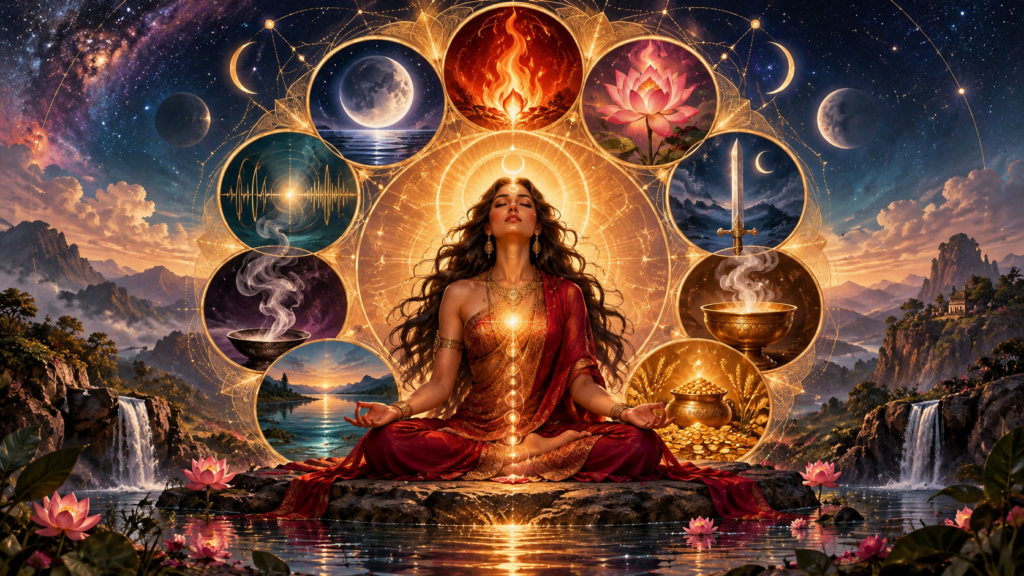
Stepping more fully into the teachings, the writing, and the wisdom of the Divine Feminine
Where the Physical and Spiritual Meet
I recently listened to a podcast in which someone spoke about two primary aspects of our lives: the physical and the spiritual. The suggestion was that these two are constantly in conversation with one another, and when one is out of alignment, the other has a way of letting us know.
Is that true? Who knows. I choose to believe there is truth in it, at least in the way I’ve experienced my own life. Our bodies often seem to know things before our minds are ready to acknowledge them. Sometimes what we experience physically invites us to look more deeply at what is happening spiritually or emotionally. And sometimes the spiritual work we do changes the way we inhabit our bodies, our relationships, and the world around us.
I don’t believe every physical challenge has a spiritual explanation, nor do I believe that alignment means life will somehow become free of pain or difficulty. But I do believe there is an ongoing conversation between these aspects of ourselves, one worth paying attention to. And perhaps that is part of why the Mahavidyas spoke to me so deeply from the beginning. Through years of study and practice, I’ve come to recognize the wisdom of the Mahavidyas in everyday life, not only in spiritual practice, but in the ordinary experiences of being human.
Their teachings are mystical and magical, filled with extraordinary imagery, symbolism, ritual, and ancient wisdom. Yet they are also deeply practical and embodied. They speak to the very ordinary and sometimes extraordinary experiences of being human: love, longing, fear, desire, loss, anger, pleasure, grief, power, aging, surrender, and transformation. They don’t ask us to transcend our humanity so much as invite us to become more fully conscious within it.
Stepping More Fully into the Teaching
I’ve been studying and practicing within the Tantric traditions that include the Mahavidyas for more than fifteen years. I’m currently enrolled in an advanced Mahavidya teacher training, deepening my relationship with these teachings in ways that continue to surprise and challenge me.
Within the lineage of my teachers, one of the central texts guiding our study and practice has been The Ten Great Cosmic Powers by S. Shankaranarayanan. His exploration of the ten Mahavidyas has provided a foundation for understanding not only their individual qualities and symbolism, but also how they collectively express the vastness of Shakti, the Divine Feminine. It is a text I continue to return to as my own understanding evolves through study, practice, and lived experience.
This work has been a central thread in my spiritual life for a long time, although I haven’t always spoken or written about it as openly as I am choosing to now. I realize that much of what I’ve shared publicly over the years, whether through my coaching, workshops, poetry, or personal reflections, has been shaped by these teachings even when I haven’t specifically named them. They are woven into how I understand transformation, how I experience the body, how I work with clients, and how I make sense of the complexities of my own life.
One of the ways I learn is through writing. It gives me an opportunity to sit with something long enough to discover what I actually understand, what I am still questioning, and what is asking for deeper exploration. Writing is also one of the ways I teach, not because I have all the answers, but because I believe there is value in sharing the questions and discoveries along the way.
So I’m stepping more fully into that here and now. In the coming months, I’ll be sharing more about the individual Mahavidyas, their collective wisdom, and how I experience these teachings in everyday life. I’ll also be offering workshops that bring some of this exploration into shared practice.
My intention isn’t simply to explain who these goddesses are. There are wonderful scholars, teachers, and practitioners who have devoted their lives to that work, and I continue to learn from them. What I want to share is how these teachings live and breathe in me, how they challenge me, and how they might offer something meaningful to others.
To begin, it feels important to share a little about who the Mahavidyas are and the story of how they came into being, at least as I’ve been taught it.
The Ten Great Wisdom Goddesses
The Mahavidyas are ten great wisdom goddesses within the Hindu Shakta and Tantric traditions. The Sanskrit word mahameans great, and vidya refers to knowledge or wisdom. Together, they are often understood as the Ten Great Wisdoms.
In the teachings I’ve received, they are ten expressions of one Divine Feminine consciousness, known as Shakti. Shakti is the dynamic, creative power of existence, the energy through which life moves, transforms, dissolves, and continually takes form.
Rather than thinking of the ten goddesses as entirely separate beings, I have been taught to recognize them as different manifestations of this one great power. Each reveals something distinct, yet all belong to the same whole. I find that image extraordinary, one consciousness expressing itself through ten very different forms, each revealing another aspect of existence and, perhaps, another aspect of ourselves.
Some of these goddesses are beautiful and inviting. Others are fierce, unsettling, and even frightening. Some are associated with abundance and pleasure, others with death, emptiness, destruction, and the unknown. Together, they offer a teaching that doesn’t exclude the difficult or uncomfortable parts of life. Instead, they invite us to recognize that wisdom can be found in places we might otherwise prefer to avoid.
The Story of a Goddess Who Would Not Be Silenced
There are different traditional accounts of the origins of the Mahavidyas. One of the best-known, and the one that has been central to my learning, begins with Sati and Shiva.
Sati, an embodiment of the Divine Feminine, was married to Shiva. Her father, Daksha, disapproved of their marriage and organized a great ceremonial sacrifice to which he invited many gods and goddesses, but deliberately excluded Sati and Shiva.
When Sati learned of the gathering, she wanted to attend. Shiva discouraged her, knowing that her father’s intentions were hostile and that attending would likely bring humiliation and conflict. But Sati was determined.
When Shiva continued to oppose her decision, Sati became furious. She was not merely an obedient wife or the daughter of a powerful father. She was the Divine Mother herself, and she was not going to allow Shiva to define or limit who she was. In her fury, she revealed her vast divine nature.
From her emerged ten extraordinary forms of the Goddess, surrounding Shiva in every direction. Wherever he turned, there she was, revealing another expression of her power. There was no direction in which he could escape her. These ten manifestations became known as the Mahavidyas, the Ten Great Wisdom Goddesses.
What fascinates me about this story is not simply its supernatural imagery, although that is certainly powerful. It’s what the story reveals about identity, authority, and the refusal to be diminished. Sati was already the Divine Mother. She didn’t become powerful in that moment. She revealed the power that had been there all along.
And perhaps that is one of the first teachings worth sitting with. How often do we forget who we are? How often do we reduce ourselves to a role, an expectation, or an identity that someone else has assigned to us? How often do we wait for permission to express something that is already alive within us?
I don’t hear this story as an invitation to disregard every concern or boundary another person might express. I hear it as an invitation to examine the places where we’ve surrendered our own knowing and forgotten the fullness of who we are. There is something deeply human in that, even within a story so cosmic in its proportions.
Ten Goddesses, Ten Doorways into Wisdom
Each Mahavidya has her own mythology, imagery, practices, and teachings. Their symbolism is far richer than any brief description can capture, but here is a glimpse of how I’ve come to understand some of their wisdom.
Kali is associated with time, death, transformation, and liberation. She confronts what must end and what we can no longer pretend not to see.
Tara offers the wisdom of guidance, protection, and the power to carry us through the unknown. She is often associated with the sound and vibration through which consciousness and creation emerge.
Tripura Sundari, also known as Shodashi, reveals beauty, harmony, bliss, and the sacred nature of desire. She invites us to recognize the Divine within pleasure and embodied existence.
Bhuvaneshwari is the vastness of space, the great cosmic mother who holds all of existence. Her wisdom invites spaciousness, perspective, and the capacity to contain what arises.
Chinnamasta is among the most startling of the goddesses. Depicted holding her own severed head while streams of blood nourish herself and her companions, she embodies radical transformation, the movement of life force, and the relationship between giving and receiving.
Bhairavi represents fierce spiritual energy, discipline, purification, and the fire of transformation. She asks what we’re willing to bring into the fire of our own becoming.
Dhumavati is the widow, the crone, the smoke, and the void. She speaks to loss, disappointment, aging, impermanence, and the wisdom that can emerge when familiar identities and comforts fall away.
Bagalamukhi carries the power of stillness and the ability to arrest movement, speech, or harmful forces. I experience her as an invitation to pause before reacting, to recognize the power of restraint and conscious silence.
Matangi is associated with speech, music, creativity, and knowledge that exists beyond conventional social boundaries. She challenges ideas about purity, belonging, and whose voice deserves to be heard.
Kamala embodies abundance, beauty, fertility, and flourishing. She invites us into a relationship with the gifts of the material world without forgetting their sacred source.
These are only glimpses, not complete definitions. Each goddess contains layers of philosophy, cultural history, symbolism, and practice that deserve far more attention, and that is part of what I hope to explore in the months ahead.
The Mahavidyas in Everyday Life: Where the Mystical Meets the Practical
One of the things I love most about the Mahavidyas is that their teachings don’t remain confined to ceremony, meditation, or philosophical discussion. They show up in life.
Kali may appear in the experience of finally releasing something we’ve held on to for far too long. Dhumavati may become recognizable in the empty space following a loss, when nothing new has yet taken shape. Bagalamukhi might invite us to stop speaking long enough to hear what is actually being said, while Matangi may challenge us to use a voice we’ve spent years keeping quiet.
Chinnamasta may confront the ways we give ourselves away without remembering to nourish ourselves. Tripura Sundari may ask us to reconsider our relationship with pleasure, beauty, and the sacredness of being alive.
These are my interpretations and experiences of the teachings, not replacements for their traditional meanings or practices. I find that distinction important. I approach the Mahavidyas with respect for the Hindu and Tantric lineages from which these teachings arise, while also recognizing that my relationship with them is shaped by my own lived experience, teachers, cultural background, and questions.
I don’t need to claim that every experience is mystical to recognize that the mystical can offer a different lens through which to understand everyday life. The teachings invite me to pay attention to how I live, what I resist, what I cling to, where I lose my center, and where I am being asked to grow. Sometimes that invitation is beautiful. Sometimes it is decidedly uncomfortable, and sometimes, despite years of practice, I still resist it.
Following a Call I Didn’t Fully Understand
As I’ve shared in some of my recent writing, I’ve created a Lion’s Gate Oracle Deck and Guidebook, a project that grew out of an inquiry that began nearly ten years ago.
In 2016, I spent several weeks in Africa, including time in South Africa with the white lions of Timbavati. That journey opened something in me that I am still exploring and writing about today. What began as an experience I couldn’t fully explain has become nearly a decade of inquiry, study, practice, and eventually the creation of an oracle deck and guidebook centered on the Lion’s Gate Portal.
I’ve thought a great deal about how that journey came to be and everything that has unfolded since. The truth is, I wouldn’t have written that book if I hadn’t answered a call I didn’t fully understand and traveled to South Africa. I couldn’t have known then where it would lead, what it would ask of me, or how deeply it would shape the years that followed.
But there is a deeper truth. I don’t believe I would have heard that call, much less trusted myself enough to follow it, if it hadn’t been for my years of studying and practicing Tantra and the Mahavidyas.
These teachings helped me develop a relationship with myself that I hadn’t known was possible before. They gave me a way to recognize what was happening beneath the surface of my thoughts, fears, desires, and familiar patterns. They helped me understand that not everything meaningful arrives with a clear explanation or a logical plan, and that learning to listen to myself doesn’t necessarily mean knowing exactly where something will lead.
That doesn’t mean I always understand what I’m hearing, or that I never question myself. I do, often. But I’ve developed a greater capacity to recognize what feels deeply true for me and to stay in conversation with it.
And this is something I want to make clear about the Mahavidyas, at least as I’ve been taught and experienced them. This teaching isn’t dogma. It isn’t a set of rules declaring this is right and that is wrong. It is a framework for understanding ourselves and the world around us in a deeply practical way.
For me, recognizing the Mahavidyas in everyday life has become less about finding answers outside myself and more about developing the awareness to recognize what is happening within me.
It gives us different ways of looking at who we are, how we move through life, what influences our choices, and what might be asking for our attention. It doesn’t eliminate uncertainty or promise that every choice will be easy. If anything, it invites us to become more conscious of the complexity of being human.
And the learning doesn’t end. Even after more than fifteen years of study and practice, I continue to discover something new about these goddesses and, through them, something new about myself. Sometimes it’s a teaching I’ve heard dozens of times that suddenly takes on an entirely different meaning because of something I’m experiencing in my life. Sometimes it’s recognizing that I thought I understood a particular goddess, only to discover another layer I hadn’t considered. And sometimes it’s simply realizing how much I still don’t know.
I find something beautiful in that. The Mahavidyas aren’t a teaching I expect to finish learning. They are a living relationship, one that continues to evolve as I do.
When I look at the Lion’s Gate Oracle Deck and Guidebook today, I can see the many experiences, people, places, and teachings that contributed to its creation. But beneath all of them is this foundation of Tantra and the Mahavidyas, which helped me develop the capacity to hear a call, trust something I didn’t fully understand, and take a step into the unknown.
Nearly ten years later, I’m still discovering where that step has taken me. And perhaps that is one of the most practical things these mystical teachings have given me: not certainty about where life is leading, but a deeper relationship with myself as I live it.
Bringing the Teaching into the Body
And that brings me back to the conversation between the physical and spiritual that first inspired me to write this article.
I don’t experience these teachings as ideas that live somewhere outside of me. They become meaningful through the body, through relationships, through choices, and through the ways I respond to the circumstances of my life.
It’s one thing to contemplate Kali and the wisdom of releasing what no longer serves us. It’s another to recognize something in our own life that needs to end and actually choose to let it go.
It’s one thing to speak about stillness through Bagalamukhi. It’s another to stop ourselves in the middle of a difficult conversation and choose not to react from fear or anger.
And it’s one thing to contemplate the void through Dhumavati. It’s another to find ourselves standing in an unfamiliar chapter of life, without the identity or certainty we’ve relied upon, and discover whether we can remain present.
This is the intersection that interests me most. Where does spiritual understanding become embodied wisdom? How does what we study change the way we live? And what happens when our daily experiences become part of the teaching rather than distractions from it?
These questions are central to my own spiritual work and to the coaching and workshops I offer. I don’t always have clear answers. In fact, the longer I study, the more comfortable I become with the possibility that some questions aren’t meant to be answered once and for all. Perhaps they are meant to be lived.
A New Chapter in an Ongoing Practice
As I move through this advanced teacher training, I find myself recognizing that this isn’t simply about learning more. It’s also about becoming more willing to share what I’ve been learning and practicing for so many years.
At sixty-two, I feel less interested in separating the different parts of who I am into neat, easily understood categories. My writing, coaching, spiritual practice, teaching, and ordinary human experiences aren’t separate lives. They are all expressions of the same life.
That doesn’t mean every part of my life is always in alignment. Far from it. But I am increasingly interested in recognizing where those different threads meet and in being transparent about the teachings that have helped shape my understanding along the way.
The Mahavidyas have been one of those threads for more than fifteen years, and I expect they will continue to challenge and teach me for the rest of my life. So this is an opening.
In the coming months, I’ll explore each of the ten goddesses more deeply, sharing their traditional stories and symbolism alongside my own experiences, questions, and reflections. I’ll also be creating opportunities to explore some of this wisdom together through workshops and embodied practices.
I imagine there will be beauty, discomfort, mystery, laughter, and perhaps a few things that ask us to reconsider what we think we know. I hope to approach it all with curiosity, respect, and a willingness to remain a student even as I step more fully into teaching.
And perhaps that is where I want to begin. Not with the certainty of someone who has arrived, but with the willingness of someone who continues to learn, to question, to practice, and now, to share more openly.
The mystical and the practical. The physical and the spiritual. The extraordinary and the everyday. Not separate worlds to navigate, but different expressions of this one remarkable experience of being alive.
An Invitation to Explore Further
Are you curious about the Mahavidyas in everyday life and how their wisdom might apply to your own experiences? Or perhaps you’re navigating a time of change, questioning familiar patterns, or feeling called toward something you don’t yet fully understand.
Through individual coaching and workshops, I offer opportunities to explore these ancient teachings in ways that are practical, embodied, and relevant to your own life. You don’t need any previous knowledge of Tantra or the Mahavidyas, only curiosity and a willingness to explore.
If you’d like to learn more about the goddesses, upcoming workshops, or working with me individually, I’d love to hear from you.

Jennifer Mark
For more than fifteen years, my spiritual journey has been deeply shaped by the study and practice of Tantra and the Mahavidyas, the Ten Great Wisdom Goddesses. These teachings have transformed how I understand myself, my relationships, and the world around me, and they form a central foundation of my work as a coach, writer, and teacher.
The Mahavidyas
This teaching offers ten distinct expressions of wisdom, each illuminating different aspects of the human experience, including desire, fear, loss, pleasure, power, transformation, and the unknown. I draw upon these teachings in my coaching and workshops to help people recognize the patterns, beliefs, and identities that may be limiting their choices or diminishing their sense of aliveness.
My approach brings together ancient wisdom, embodied awareness, personal inquiry, and practical application. Rather than offering prescribed answers or rules about right and wrong, I create opportunities for people to explore their own experiences, recognize what is asking for attention, and discover what may need to change, be released, or more fully embraced.
I believe the mystical and the practical are not separate. The wisdom of the Mahavidyas becomes meaningful not simply through study, but through how we live, the choices we make, and our willingness to meet ourselves with greater honesty and awareness.
I am not here to tell you who you should become. I am here to help you recognize the patterns that obscure who you are, so you can move through life with greater clarity, freedom, and a deeper connection to yourself.
Sources and Further Reading
-
Tantric Visions of the Divine Feminine: The Ten Mahavidyas by David Kinsley