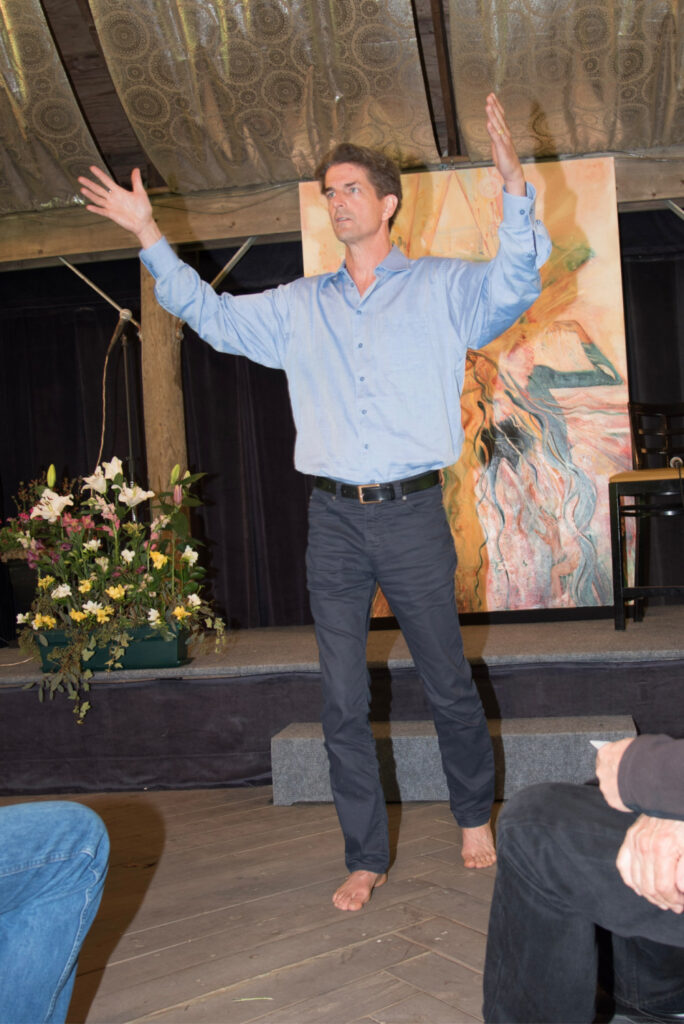
Talking ‘Bout Lazarus
In 1987, I came to Shalom Mountain and went on a retreat led by Jerry Jud. Only after a few more retreats did I realize that I didn’t have a particularly transformative mat trip that first time. What I did have was a life-changing, profound, and heart-exhilarating experience of loving community. I was blown away that people could show up this real and open, and practice intentional loving with each other. I sensed my belonging.
As part of the Sunday morning celebration that lands a Shalom retreat’s expansive healing, Jerry would tell the story of Jesus raising Lazarus from the tomb. I remember being enthralled and shaken.
Jerry introduced his telling of this old biblical story by announcing his intention to tell the present truth of the Lazarus story. He’d say, “People back then wrote down all this stuff about Jesus and what he was up to. They really did their best, and we’re grateful; but they left a lot of things out. So, when we notice something’s missing, we can take up our responsibility to put it in there.” This was such a radical theology for me. It’s a beautiful and bold way to keep our religious teachings & spiritual lineages alive while recognizing both the human gift and the human failure that’s woven through everything. I still love it.
What struck me at first wasn’t simply the content of Jerry’s additions to the story of Lazarus, although I was startled to hear Jerry proclaim that he figured that Jesus was lovers with Lazarus, and with Mary and Martha, Lazarus’ sisters. At the time, Jerry, Georgeanne, and Be were living publicly in a triad relationship, and Jerry was clearly exploring his own experience of intimate loving through fleshing out the story. So, as he told it: At the time that Lazarus was struggling with the “sickness unto death,” Jesus, tired out from work in Jerusalem, was heading for full restoration with his lovers in Bethany.
What cracked open my heart was when Jerry stopped just spicing up an old set biblical tale and made the liberating turn by revealing that: “This is our story. Made more true now.” I was fascinated by the audacious and self-respecting act of authorship itself. In recognition that the world and our experience is different now, we can evolve our core myths to tell our present truth.
I was thrilled by this. All that we had just witnessed and participated in around the mat had been prefigured in a two-thousand-year-old story of Jesus performing a miracle. All that we had done in rolling away the stone that blocks the tomb, and calling each other back into life, and celebrating transformation by lifting each other up into the air with a song on the stereo was a fresh and real iteration of an ancient primal truth of healing in community. Jerry would say: “No need to get caught up on the historical accuracy of the details. We know the story is true because we’ve lived it ourselves.”
I think now that I decided I wanted to lead Shalom retreats just so I could tell the Lazarus story. I wanted to be a person who got to sit at the front of the Shalom room on Sunday morning, in the heart of community, and tell us our story.
Make it Human
For the next set of years, I lived in Chicago and was away from Shalom. When I came back, Joy Davey and Lawrence Stibbards were leading the Mountain and, of course, were telling their version of Lazarus at the end of retreats. They added in Mary and Martha as full dramatic characters.
I remember being put off at first—this wasn’t how Jerry had done it. Then I caught myself. The boldness to make a story more true that had excited me so much with Jerry was still at play. Ours is a living story. It evolved, and that evolved version delivered new meanings to me.
There’s a time when Jesus comes into the valley and stands before the tomb of Lazarus. And the bible says: Jesus wept. It’s only twice that he gets described as weeping.
The first is as he overlooks the city of Jerusalem. Jesus’ tears for the suffering in our collective social life mattered to Jerry because he was adamant that we are called to service in the world. The point of doing the inner work is to make us capable of showing up for the outer work. Jerry used to say: “there is no authentic inner journey without an engaged outer journey.”
In front of the tomb, Jesus weeps for the death of his friend. These second-recorded tears are personal—the loss of the beloved. I remember being grateful for the teaching that we’re called to hold both—we grieve for the whole world, and we grieve for the people we love intimately. The Lazarus story holds both kinds of sorrow.
The more retreats I came on, and the more times I listened to the Mary & Martha act, ecstatic on a Sunday morning, the more I appreciated what Joy and Lawrence had done. They brought into our story this humanizing element—the recognizable realness of personality and feeling.
In the “Mary & Martha” version of Lazarus, as Jesus approached the house, Martha would come storming out at him, demanding to know where he’d been, telling him how he’d failed his friend, and Jesus would offer as an aside to us, the community, some comment about needing to gird his loins before facing her. We’d all laugh in delight, but underneath the laughter was something deeper.
As Lawrence played this comic deference to Martha’s angry judgment, he offered ordinary human humility amidst all the inexplicable divine happenings of the retreat. We were laughing together about our common humanity. The imperfection. The difficulties. The inescapable messes. The reality that 90% of life is just showing up and bringing all you’ve got.
And when it did become my time to tell Lazarus, I loved getting to enact it with Jennifer Mark and Jess York. Jess’s Martha was sharp & fast: “Jesus Christ! Where the hell have you been?” Jennifer’s Mary was wonderfully weepy & guilt-slinging: “Oh, don’t you worry yourself about your dead friend, Lazarus. It’s really okay. I’m sure you’ve been off doing very important things.” We were a fabulous team, and I was always grateful to play in that space together.
As I told the story, one of the pieces I added came after Lazarus had emerged resurrected from the tomb. When I got to where Jesus says, “Unbind him and let him go,” it mattered to me to point out that Jesus doesn’t say: “Now that I’ve brought you back to life, you can follow me around and carry my briefcase.” Love is a gift. The resurrected person is truly released.
This part is important to me because on a Shalom retreat people are finding new life, which brings accountability, but the obligation isn’t to us as leaders or this particular weekend’s community. The responsibility is to your own life. The call is simple: “Go and Love well. You now know how.”
Enjoy the Party
Then in 2019, Shelly Reichenbach and I became involved in planning Jerry’s 100th birthday celebration at the Mountain. We went out to Timshel to spend time with him and get his ideas about how he wanted to be celebrated.
For the last few decades of his life, Jerry was devoted to his ritualized morning vibration practice. He’d wake up each of his chakras with these enormous industrial-sized vibrators. His method was strong and not subtle, and it set the ground for “feeling good” all day.
Ever eager to turn people on to his discoveries, and as part of his birthday festivities, Jerry wanted to sit in his Barcalounger and vibrate himself into ecstasy while the community watched. Shelly started figuring out how to get the Barcalounger onto a giant lazy Susan, like the kind used at car dealerships, so he could rotate while vibrating, and everyone could get a good view.
And then Jerry died. Suddenly, his 100th birthday party became his memorial service. I was invited to tell the Lazarus story, and I felt honored to offer back to Jerry the story we had learned from him. It felt right for who I was in the community, in leadership, and in the lineage.
Just before the main memorial service started in the Pavilion, I was sitting next to Maeba Jonas. We were trading notes on how we each had prepared what we were about to say and then intended to let the Spirit take over—that classic minister’s understanding that you work up a sermon as much as you can and then trust what comes. And all of a sudden I thought: “Shit.”
I hadn’t prepped a fresh final section for the Lazarus story, but I needed it because Jerry was actually dead. It wasn’t going to be OK to honor someone who was truly dead with a story of a miraculous embodied resurrection and the charge to: “Go forth and Love well!”
So, when it was my time, trusting that a good ending would arrive by Spirit, I got up and started the story. I told of Jesus standing with the loving community at the edge of Lazarus’ sealed tomb. I talked about how Jesus had divine power enough that he could have rolled away the stone all by himself but instead invited the people to do it. Active participation in calling someone into life demonstrates to us that we are worthy of trust. I pointed out how Jesus never enters the tomb. He stands close and calls three times: “Lazarus! Come forth!” Because none of us can be pulled out of our own dead places.
Then I came to the end of the version I knew. I began to tell how the resurrected Lazarus went off and lived more full life. Eventually he got sick again, and this time it truly was a sickness unto death. Lazarus died a second time.
Just a few months earlier, at age 99, Jerry got sick, and Jerry died. The people gathered. They bathed his body and wrapped him in a shroud. They placed him in a hole in the side of the valley. They rolled a stone in front of the opening and left it there.
Jerry’s soul, recognizing that he had really died, ascended to heaven. And when he got there, exactly what he’d always told us would happen happened. He met God. And the first thing God said was: “Did you enjoy my party?”
Scribe’s Reflection
There are some stories I have the privilege of listening to as a scribe, and then there are stories I find myself living inside. Jeff’s story is one of those.
As I listened to him speak about Lazarus, I was remembering my own years at Shalom, the retreats, the community, the laughter, the tears, and the extraordinary experience of being witnessed and loved in places we may have believed were beyond reach. I was also remembering what it meant to stand beside Jeff and Jess, playing Mary and Martha while Jeff brought Lazarus to life once again.
What strikes me now is how much this story has always been about more than resurrection. It is about our willingness to participate in one another’s return to life.
Lazarus Story
Jeff speaks about Jerry’s invitation to take an ancient story and make it true for the people living it now. I find myself sitting with that invitation. How often do we treat our stories as something fixed, something already written, something we can only repeat? And what becomes possible when we recognize that while we cannot change what happened, we can change our relationship to it?
In many ways, that question lives at the heart of my own work as a scribe. I listen as someone tells a story, often one they have carried for decades. I reflect it back, and then it returns to their hands. They can leave it exactly as it is, or they can see something they hadn’t seen before. The story belongs to them. It always did.
I am particularly moved by Jeff’s telling of the moment Jesus asks the community to roll away the stone. He doesn’t do it himself, although, according to the story, he could have. He asks the people gathered to participate. And then he stands outside the tomb and calls Lazarus forth.
There is something profound in that distinction. We can help remove the stones. We can stand beside someone, witness their struggle, love them, and call to the life we know is still there. But we cannot walk out of the tomb for them.
And when Lazarus finally emerges, he is not asked to spend the rest of his life repaying the one who called him forth. He is unbound and released into his own life.
I love Jeff’s addition about not having to carry Jesus’ briefcase. It makes me laugh, but it also carries a truth I think is essential. Love is not ownership. Healing does not create indebtedness. The gift is the freedom to go and live, to love well, and perhaps, when the moment comes, to help roll away a stone for someone else.
There is another part of Jeff’s story that stays with me. His memory of being initially uncomfortable when Joy and Lawrence changed Jerry’s telling of the Lazarus story. The very freedom that had so inspired him became something he had to recognize again when someone else exercised it.
Isn’t that wonderfully human? We can fall in love with a teaching about change and still find ourselves resisting change when it arrives. Even our most cherished stories can become stones if we insist they must remain exactly as we remember them.
I smiled as Jeff recalled the three of us bringing Mary, Martha, and Jesus into the room. I remember the delight of those moments, the freedom to be irreverent, emotional, imperfect, and fully human inside something sacred. There was never a requirement that holiness look solemn. Sometimes it arrived through laughter, sarcasm, theatrical grief, and the willingness to play together.
And perhaps that is part of what Shalom taught me. We do not have to become less human to experience the divine. We become more fully human.
Then Jeff takes us to Jerry’s memorial, and the story changes again. This time, theLazarus story does not simply emerge from the tomb and continue living. This time, death is real and final. Jerry is gone, and the familiar ending no longer holds what needs to be held.
I find something deeply moving in Jeff recognizing, just moments before standing to speak, that the story needed another ending. Not because the old one had been wrong, but because life had brought them somewhere new.
And isn’t that what Jerry had been teaching all along?
The story must remain alive enough to hold the truth of the moment.
I am struck by the tenderness of Jeff allowing Lazarus to die again, allowing Jerry to remain dead, and still finding a way to honor the life that had been lived. There is no attempt to deny mortality or turn grief into something more comfortable. There is instead an invitation to recognize that resurrection may not always mean returning to the body. Sometimes it is what continues through the people who loved us, the stories we told, the lives we touched, and the freedom we gave one another to live more fully.
And then comes that extraordinary final question.
“Did you enjoy my party?”
I laughed when I heard Jeff tell it, and I was moved by it too. Because after all the teachings, all the retreats, all the inner work and outer work, all the stones rolled away and lives called forth, perhaps there is something wonderfully simple about that question.
Did we allow ourselves to be here? Did we love? Did we participate? Did we grieve when grief came and celebrate when celebration was possible? Did we make room for one another in the great, messy, beautiful experience of being human?
I don’t know what happens after death. I don’t know whether we meet God or what God might ask us. But I find myself delighted by the possibility that the question could be less about what we accomplished or got right and more about whether we actually lived.
As I reflect on Jeff’s story, I recognize that the Lazarus teaching continues to unfold in my own life. I am still discovering stones I have placed in front of my own tombs. I am still learning when to reach for someone else’s stone and when to simply stand beside them and call their name. And I am still learning to let the stories change as I change.
That may be one of the greatest gifts of a living lineage. We are not merely preserving what was handed to us. We are invited to participate in its becoming.
Jeff has done that with Lazarus. Jerry did it before him. Joy and Lawrence did it in their own way. And now, through Jeff’s telling, the story continues to find new life.
I am grateful to have been part of that story, both in the Shalom room and now as the one listening and reflecting it back.
And I find myself wondering, when my own time comes, whether I will be able to answer that final question with a full heart.
Did I enjoy the party?
I intend to keep living in a way that allows me to say yes.
Jennifer Mark, Scribe
Voices That Matter-The Scribe Project
Storytelling as legacy. Listening as medicine
This story is part of Voices That Matter: Shalom’s 50th Anniversary
There is no cost to participate. Only a willingness to share a story.
This project, like all community offerings within Voices That Matter – The Scribe Project,
is sustained through the support of those who feel called to be part of it,
by sharing stories, spreading the word, or contributing to its creation and ongoing life.
If you feel moved, you are welcome to contribute in whatever way feels right.
Shalom holds 50 years of stories.
I would love to include yours as part of this growing living archive.