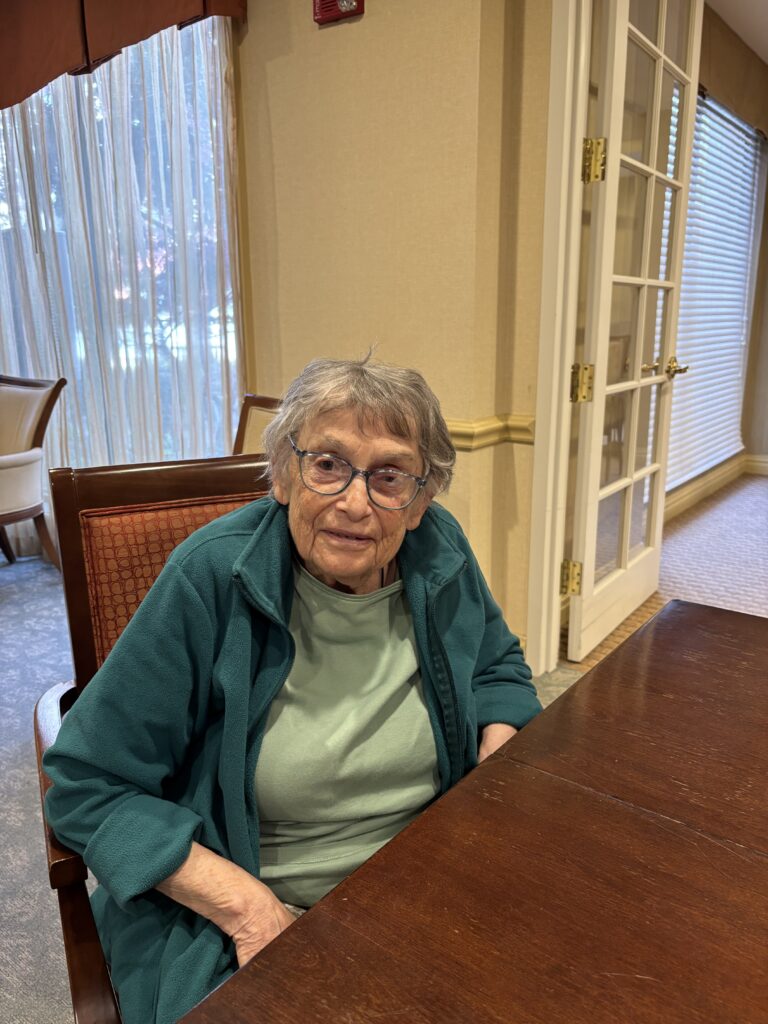
What Is Still Worth Doing
For the last several years, I have found myself thinking about what, exactly, I still wanted to do with my life. My husband was sick for seven years before he died, and illness has a way of shrinking a life. In the beginning, we could still go places, still do things, still imagine a future that looked somewhat like the one we had planned. But little by little, his illness limited what was possible. It narrowed our world. And after he was gone, I found myself wondering what was still worth doing with the life I had left. I wasn’t even sure recording my story, writing it down, preserving it in some form, was a worthwhile thing to do.
Lately, though, I have been thinking about my mother.
She lived to be one hundred and eight. She died seven or eight years ago, and only now, all this time later, have I found myself circling the question I never asked her.
What did she think when they placed me in her arms and told her, I think this baby is blind?
The Question I Never Asked
I never asked her. I don’t know why I never asked. Maybe because I spent so much of my life taking credit for everything that came after. I was ambitious. I was smart. I wanted something for myself. I was not going to sit at home on my behind and do nothing. That was the story I told myself. That I had made my own life by force of will. And I did have will. I had drive. But lately I’ve started wondering how much of that was mine alone, and how much began with my mother.
When I look at old pictures of us, she looks like what she was, a mother with a baby on her lap that she loved. She was strict. She was nervous. Life made her that way. But when I look now, I see something else too. I see a woman holding a child the world had already begun to define by what was wrong with her, and loving her anyway.
My Father and My Mother
My vision disability was caused by something my father passed to my mother before I was born. He had been fooling around, as they used to say, and gave her a disease that affected me. I didn’t know that until I was an adult. And even then, I never held him responsible in the way perhaps other people would have. I never believed he set out to hurt me. I don’t think he intended any of it. My sister, his daughter from his second marriage, tells me he cheated on her mother too. That was simply who he was. We all have something. That was his. He had five more children after he left my mother, and if none of that changed him, nothing was going to.
But my mother was different.
She did not hover over me.
Enough to Make a Life
In my mind, this is how it happened. She had been told there was something very wrong with my eyes, that I might be blind. But then she watched me. She saw me follow things with my eyes. And somewhere in herself, she must have decided, this baby can see. Maybe not the way other children see, but enough. Enough to live. Enough to move through the world. Enough to make a life. And because she decided that, she let me do whatever she believed I could do.
I do not remember her ever telling me I could not do something because of my sight. I do not remember her saying, no, you can’t go there. No, you can’t ride the subway. No, you can’t do that by yourself. Children teased me, yes. Perhaps they wouldn’t now. Perhaps the world has changed enough for that. But inside my own home, I was not taught to see myself as fragile.
That does something to a person.
Helped Without Being Diminished
My mother had her own burdens. After my father left, she had a hysterectomy. In those days, women were not given hormones afterward. She had two teenage daughters and me, and she was difficult to live with. I can see that now in ways I could not then. She was strict. She was nervous. Life had made her tired. But I never doubted that she loved me. Never. And if there was something I truly needed, if it was the right thing, she did it.
My husband was always good to me, too. He understood what it meant that I could not drive. He never made my limitations heavier than they already were. There is grace in being helped without being diminished by it. I was lucky to know that in both of them.
If I Could Speak to Her Now
If I could speak to my mother now, I would ask her the question I should have asked long ago.
Mom, what did you think when they put this baby in your arms and told you something was wrong with her?
And because I am a mother myself, I think now I know the answer.
Your heart would break for the child. For the family. For the life you suddenly realize may be harder than you imagined. But you would love the child. You would do everything you could to make her life something she would still want to live. That is what I believe she did for me.
I don’t know if she ever knew exactly why I was born with impaired vision. I don’t know if she and my father ever spoke of it plainly. She never brought it to me, and I never brought it to her. Some things in families remain unspoken not because they are unknown, but because silence becomes its own form of protection. I would not have wanted to hurt her by asking. If I had spoken to her not as a daughter, but as a woman, as a sister, as a friend, I think I would have told her this: You are doing a beautiful job with your daughter.
A Blessing and a Burden
In many ways, my blindness was simply ignored. That was both a blessing and a burden.
People did not know what to do with disabilities then. No one asked what I could do. They were far more interested in what I could not. I remember hearing whispers when I was young, who is going to marry her? A blind woman. That was how people thought. Not what kind of life will she build, not what gifts does she have, but who will take her.
I got a job at Alexander’s in New York and I was doing well. Then they got my medical report and fired me. Just like that. I was in college then. That was how it worked. Before disability protections changed, employers could simply decide you were too much trouble. Later, when the law changed, it opened a world to me that had not existed before. A question on an application became, for the first time, a door instead of a wall.
The Life I Built
I had wanted to be a French teacher. I loved French. I loved languages: French, Italian, and Spanish. They came easily to me. But public schools would not have hired me then, and if they would not hire you, city colleges had no interest in preparing you for that future. So I changed course. I went into special education instead, because I was always good with children. And I loved that work. I truly did. But I loved French too. Both things are true.
My mother never sat me down and asked if I wanted to go to college. But the people around me were going, and I said I wanted to go too. She didn’t say yes with fanfare. She didn’t map out a future for me. But she also did not say no. She did not stop me. I took the exam for City College, passed, and because I passed, it was free. That is how I got there. Sometimes your whole life is changed not by who pushes you forward, but by who does not stand in your way.
The Family I Found Later
And now, all these years later, I have sisters and brothers I did not grow up with. My father’s other children. Imagine that. I met my sister eleven years ago, and we have kept each other since. She lives in England. She has her own physical challenges. We are open with each other. We talk about my mother. We do not talk much about hers. She knows her mother was not kind to me. When I called my father, she would say, “You’re bothering your father,” as though I were not his child too. It was hard. Harder than it needed to be. But I never felt deprived. I always had food. Clothes. A roof over my head. Not always an easy life, but enough.
As a child, I used to ask my father when he was coming home to sleep. He would say, soon. I waited.
I am still waiting.
A Lifetime of Adapting
These days, living at Atria, people sometimes treat me like any other old person with aging problems. And I find myself thinking, what some people are only just learning in old age, I solved years ago. I have lived a lifetime adapting. A lifetime learning how to move through the world with less sight than other people and more determination than many of them knew what to do with. But now it is harder again. I moved to Atria on July 19, 2025. I stopped reading for a long while after that. Before I moved, I belonged to a book group. I read large print. Now I can still read some, in pieces. Enough to keep going.
And that, really, is the story of my life.
I do what I can with what I have.
That is all I have ever done.
This Is Me
This is me. I do not know another way to be. Maybe that is because my mother never taught me to think of myself as less. Whatever I do, I do with what I have. I love to walk. They ask if I want the driver to take me, and I say no, I love to walk. So I walk. And I will keep walking until I can’t.
I used to think everything I became was because of my own drive. My own ambition. My own refusal to sit still and be limited by what other people thought they saw when they looked at me.
Now I know better.
It was not only my drive.
It was hers, too.
The Question
My eye doctor still says to me, sometimes, I don’t know how you did what you did.
But to me, the answer has always been simple.
What was the alternative?
Scribe’s Reflection
Some stories peak loudly through achievement, through milestones, through the visible shape of a life.
And then there are stories like Maxine’s.
Stories that reveal the quiet courage of adaptation.
The kind that happens daily.
Privately.
Without applause.
What moved me most listening to Maxine was not only her resilience, but the way love and limitation lived side by side throughout her life without hardening her heart. Again and again, she returns to a simple truth:
“I do what I can with what I have.”
There is something deeply honest in that.
No performance.
No self-pity.
No grand rewriting of hardship.
Just a woman meeting life as it came and continuing forward anyway.
As Maxine reflected on her mother, I found myself thinking about the invisible ways we shape one another’s lives. Sometimes what changes a person most is not who pushes them forward, but who refuses to define them by what is broken. Her mother did not teach her to think of herself as less, and that quiet decision echoed across an entire lifetime.
This story also carries something many families understand deeply:
the things that remain unspoken.
The questions we never ask until years later.
The love that exists even inside imperfection.
The complicated humanity of parents.
The way grief, protection, silence, and tenderness can coexist all at once.
What stays with me most is Maxine’s determination to keep walking.
Literally and metaphorically.
“I will keep walking until I can’t.”
There is dignity in that sentence.
There is devotion to life in it.
And there is wisdom.
Maxine’s story reminds us that resilience is not always dramatic.
Sometimes it is simply the decision to continue living fully with what is available to you.
To adapt without surrendering yourself.
To love life enough to keep participating in it.
And perhaps most beautifully, her story reminds us that the ways we are loved early in life can become the foundation beneath everything that follows.
Jennifer Mark, Scribe
Voices That Matter
Storytelling as legacy. Listening as medicine.
Every resident carries a lifetime of moments, memories, losses, laughter, love, and wisdom that deserve to be seen and remembered.
Atria Stories exists to pause, listen, and honor the lives that have shaped families, communities, and generations.
Because these are not just stories from the past.
They are living legacies still unfolding.