Finding My Way to Shalom
I first came to Shalom in September 2012 for the Men’s Gathering. Everything was very new to me, and there was definitely some awkwardness at first. But I fairly quickly got over that and dropped into the experience. I came back the following year, and not long after that, I began helping to lead the Men’s Gathering.
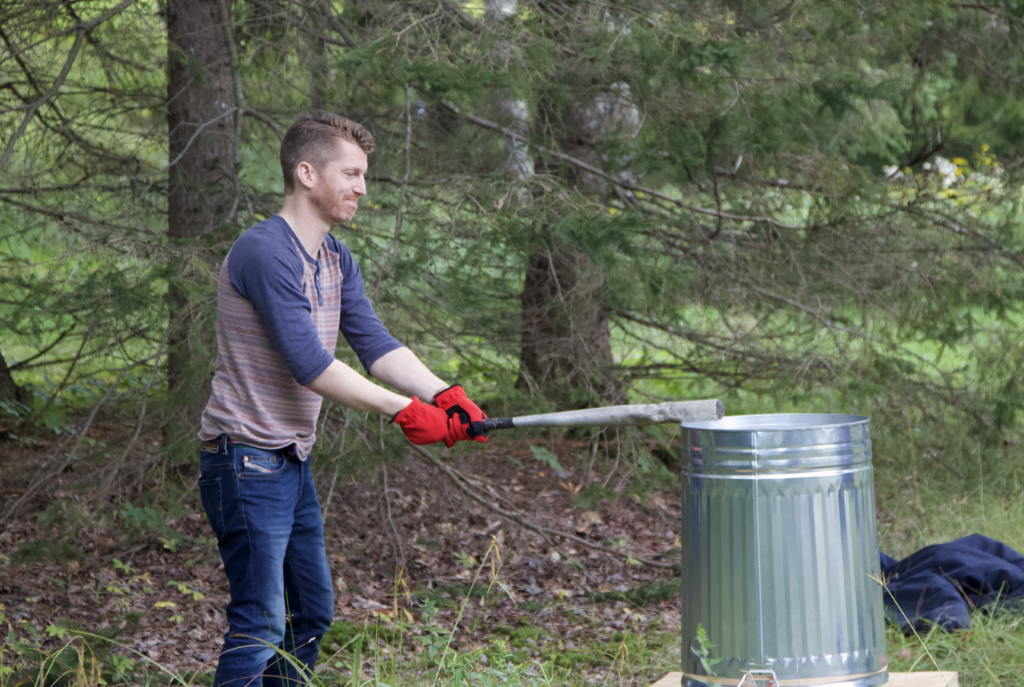
One of the things I remember from those early years was hearing about a process they used to do at the Men’s Gathering. Jim Sullivan told me that they used to take a metal garbage can and a baseball bat and just destroy the garbage can.
I was fascinated by that. I remember thinking, wow, that sounds interesting. That sounds a lot more fun than hitting a cube.
There’s something interesting about people’s reactions when you mention anger work. I’m a Core Energetics practitioner now, and I see it a lot. There’s often this smile that comes across someone’s face, a little curiosity, and even some excitement. There’s something about the possibility of expressing all that energy that gets people excited.
So we decided to bring the garbage can process back.
In 2017, we bought a couple of metal garbage cans and figured out how to make the process safe. We attached the cans to the wooden platform that had been used years before for the wooden mallet work. We needed something stable to keep everything secure, and then we just let people have at it.
As more and more men took their turns, the garbage can would get smashed down into this sculpture-like thing. It was amazing how something that started out as a full-sized metal garbage can could become maybe a twentieth of its original size. Then we’d get another one and go at it again.
We did that for a number of years at the Men’s Gathering. It was a process that had existed for years before us, and we brought back it into the experience.
The Power of Emotional Release
What fascinates me about that process is how it speaks to the power and opportunity of Shalom.
As a Core Energetics practitioner and a retreat leader at Shalom, one of the big things I’ve been taught to do is look for an outsized reaction from a client or retreat participant. That’s often the breadcrumb trail that leads to what they’re carrying, what their history is, and what’s going on underneath the reaction.
We’re all carrying so much. One of the ways I explain it to my clients is that ten people do something wrong to us, and then the eleventh person gets the blame for everyone before them. We carry these experiences, and they build up inside us. Then something happens in the present that touches all of that history and then it can come out in messy ways. I believe that we have a responsibility to know what we’re carrying and find ways to release it before it comes out inadvertently.
The opportunity at Shalom is to give people this gift of release, where they can clear some of what they’ve been carrying.
What’s interesting about the garbage can process is that there doesn’t necessarily have to be a story attached to it. You don’t have to explain what you’re angry about before you begin. Sometimes you can just start hitting.
I heard about Core Energetics practitioners who sometimes begin their sessions by having someone come in and just start hitting. There’s something about allowing the body to move and express what it’s holding without first needing to figure everything out.
And I think there’s something particularly satisfying about having an actual effect on something.
With a foam cube, you can hit it over and over, but nothing really changes. I’ve used those foam-covered bataka sticks, and sometimes they just make me more angry. At least with a tennis racket, you get the sound. You get some kind of response which allows more of an emotional release.
With a metal garbage can, you can actually see the effect of what you’re doing. The object changes. There’s a physical impact, and there’s something about that which speaks to what the nervous system is wanting.
I think about that scene in the movie Office Space, where they destroy the printer. That scene is burned into so many people’s consciousness because it gave space to something we’re all hungering for.
For me, the garbage can process represents something much bigger than smashing an object. It speaks to the opportunity we have at Shalom to make room for expression and release.
From Shalom to Core Energetics
My first experience at Shalom also opened another important door in my life. At that first Men’s Gathering in September 2012, I met Jim Haesig. Jim had recently left a business he owned and was moving into the next phase of his life. I was trying to do something similar myself, so he was someone I looked up to. He very quickly became a mentor to me.
During that weekend, Jim told me about Core Energetics. About two weeks later, he reached out and said there was a Core Energetics introductory weekend happening in Danbury, Connecticut. At the time, I was living about six miles away.
I remember thinking, wow, this is exactly what Jim was telling me about a couple of weeks ago, and now it’s happening just a few miles from my house. I can’t say no to this. I just can’t.
So I went. That introductory weekend was the first module of the academic year, and I immediately signed up for the four-year training. I went from my first experience at Shalom into Core Energetics training and eventually became a practitioner.
Today, I have a Core Energetics practice in New York City, and I’m also on the faculty at the Institute of Core Energetics, where I teach. I’m leading retreats at Shalom as well. It’s been a wonderful journey, and I love it.
Building Community Through the Shalom Process
One of the things I’ve learned so much about through Shalom is how to build community. I don’t think people who haven’t experienced it would necessarily believe that it’s possible to galvanize a group of people that quickly and that deeply. But I’ve seen it happen again and again.
There’s something really amazing about the way the Shalom process creates connection and safety among people who may have only just met.
Susan Davidson and I have actually brought a lot of the community-building practices we use at Shalom into Core Energetics. Things like the bicycle chain and the use of stories have helped us build more community, safety, and connection there.
That’s one of the things I value so much about Shalom. It’s not just the individual work that’s happening. It’s also what’s happening collectively, the way people come together and create something that allows everyone to go deeper.
I’ve really enjoyed moving into retreat leadership. I now lead the Men Loving Men retreat, which John Bottone recently stepped back from, and I lead a couple of other retreats each year.
I’ve gotten a lot of great support from LJ, Nance, and Sandy in helping me become a better leader. There are really good things happening within the leadership and the community, and Shalom has informed my life in so many different ways. It continues to do so.
The Gift of the Invitation
When I think about how to describe Shalom to someone who’s never been there, I often come back to the idea that when you know it’s right, you know it’s right.
Sometimes someone asks you in just the right way, and you know not to ask too many questions about it. That’s part of the knowing. You recognize that if you start going down the path of asking too many questions, you’re probably just looking for an off-ramp.
I’ve thought a lot about the importance, and gift, of the invitation, and it’s something I try to bring into my retreats. I ask people to consider who in their lives they might offer that gift to.
We have retreats that don’t always fill up, and there are so many people out there who could benefit from what we’re offering. But it takes something to extend that invitation. Sometimes it takes individual work to get ourselves to a place where we’re ready to offer it.
I think there’s something really important about recognizing that the invitation itself is a gift. Someone offered that gift to me, and it changed the direction of my life.
Being With Jerry Jud
Another meaningful part of my Shalom experience has been getting to know Jerry Jud.
I met Jerry for the first time at Shalom’s fortieth anniversary. I remember being nervous about meeting him. I asked Shelly to introduce me because, well, it was Jerry.
Over the next several years, I made a few trips to Timshel, and I had some really beautiful times there. It was wonderful to get to meet him and spend quality time with him.
I was also with Jerry just a couple of days before he died. By that point, he wasn’t really speaking, but being with him during those last days was meaningful to me.
When I think about Jerry now, and about how Shalom has reached its 50th anniversary, I think about what I would want him to know. I would probably just want him to know that Shalom is in good hands.
There’s really good stuff happening. We’re evolving individually, collectively, and within the process itself. There are new people coming on board all the time who are helping with that evolution.
I think that’s what I would most want to share with him. The kids are going to be okay!
Continuing the Work
When I look back at that first Men’s Gathering in 2012, I can see how much has unfolded since then. I came into Shalom not really knowing what to expect. Everything felt new, and I had to move through some initial awkwardness before I could drop into the experience.
What followed changed the direction of my life. I met people who became important mentors, discovered Core Energetics, went through four years of training, became a practitioner, and eventually found myself helping to lead the very kinds of experiences that had been so meaningful to me.
And I’m still learning. I continue to be amazed by how quickly and deeply people can connect through the Shalom process, by the opportunities we have to release what we’re carrying, and by the community that makes that possible.
I love being part of the retreat leadership. I love having the opportunity to create these experiences for other people, and I appreciate the support I’ve received along the way.
There really are good things happening at Shalom. The people are evolving, the community is evolving, and the process continues to evolve. For me, Shalom has been and continues to be a place that informs my life in so many different ways, and I think that’s worth sharing.
Scribe’s Reflection
As I listened to Ben share his story, I was struck by how something as simple as an invitation can change the direction of a life. He arrived at Shalom not quite knowing what to expect, and what unfolded became far more than an experience at a retreat. It opened a doorway into work that would become part of his life’s purpose, into relationships that would shape him, and eventually into his own role as someone extending that same invitation to others.
What We Carry, What We Release
I found myself particularly drawn to his description of the garbage can process. There’s something almost humorous about imagining a group of grown men taking turns smashing a metal garbage can with a baseball bat. And yet, beneath that image is something profoundly human. How much do we carry that never finds a place to go? How often do we expect ourselves to understand, explain, or justify what we’re feeling before allowing it to move through us?
Ben speaks about emotional release as something that doesn’t always require a story. That stayed with me. So often, we believe we have to know why we’re angry, why we’re hurting, or where something began before we can let it go. But perhaps there are times when the body knows something the mind hasn’t yet found words for. Perhaps being permitted to express what we’ve been holding is itself part of the healing.
What also stood out to me was how seamlessly Ben’s story moves between individual transformation and community. The release matters, certainly, but so does the space that makes it possible. The willingness of people to show up for one another, to witness without needing to fix, and to create enough trust for something real to emerge. I have experienced that within Shalom myself, and I continue to be struck by how much can happen when people feel safe enough to be fully present.
The Gift of the Invitation
There was another thread running through our conversation that I found especially meaningful: the gift of the invitation. Someone invited Ben into an experience that changed his life. Years later, he is helping create those experiences for others. What began as an invitation became a practice, a profession, a community, and a way of giving back.
And then there was his reflection on Jerry Jud. When Ben imagined what he would want Jerry to know about Shalom today, his answer was simple: Shalom is in good hands. I heard something beautiful in that. Not an attempt to preserve something exactly as it once was, but an acknowledgment that what was created is still alive, still growing, and still finding expression through the people who carry it forward.
As a scribe, I am reminded again that we don’t always recognize the significance of a moment while we’re living it. An invitation accepted, a conversation with someone who becomes a mentor, or a weekend that begins with uncertainty may become part of a much larger unfolding.
Ben’s story leaves me thinking about the gifts we receive and the gifts we become willing to offer. Sometimes what we release creates room for something we couldn’t have imagined. And sometimes the greatest gift is simply opening a door and inviting someone else to walk through it.
Jennifer Mark, Scribe
Voices That Matter-The Scribe Project
Storytelling as legacy. Listening as medicine
This story is part of Voices That Matter: Shalom’s 50th Anniversary
There is no cost to participate. Only a willingness to share a story.
This project, like all community offerings within Voices That Matter – The Scribe Project,
is sustained through the support of those who feel called to be part of it,
by sharing stories, spreading the word, or contributing to its creation and ongoing life.
If you feel moved, you are welcome to contribute in whatever way feels right.
Shalom holds 50 years of stories.
I would love to include yours as part of this growing living archive.